ETH real yield in 2026: staking rewards vs supply growth
ETH staking paid 2.46% a year while supply grew 0.86%: a 1.59% real yield. Issuance, burn and stake data, and what it means for institutions.

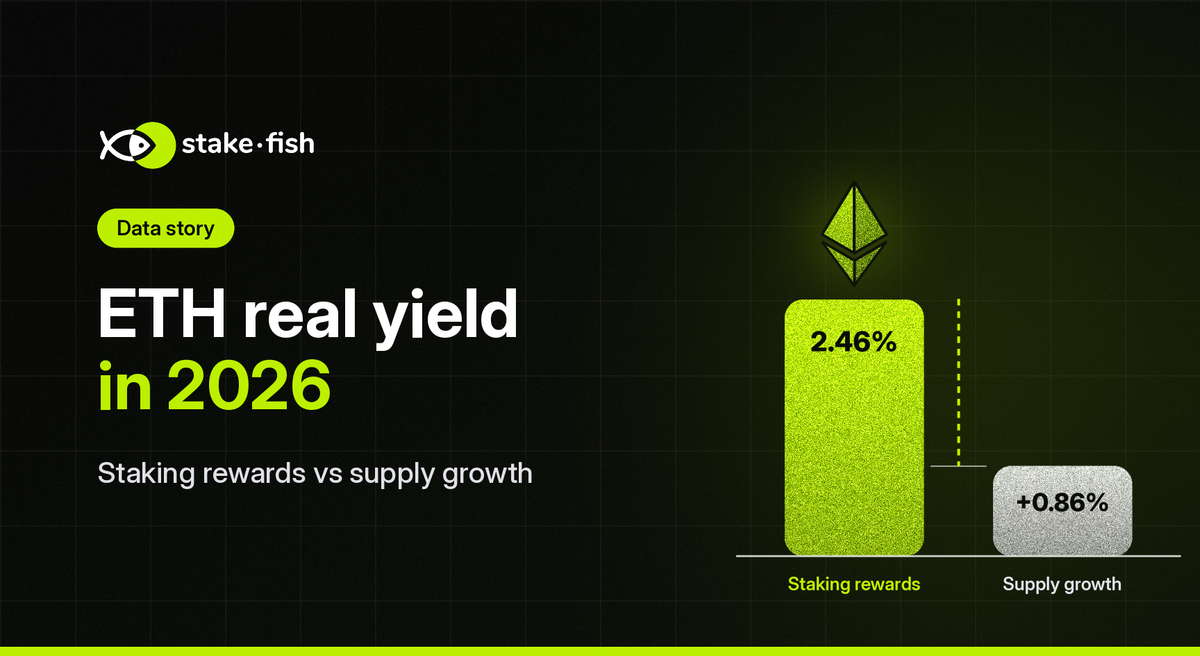
1.59%. That is the real yield on staked ETH over the last 30 days. Staking paid 2.46% a year in new ETH. The ETH supply grew 0.86% a year. Real yield is what is left after supply growth: how fast a staker's share of all ETH grows (stakefish analysis of ultrasound.money supply and burn data and the Beacon API, October 25 to November 24, 2026).
A holder who does not stake goes the other way. Their share of the supply shrank by 0.85% a year at the same pace.
Here's where the numbers come from, why ETH supply grows again, how the amount staked sets the rate, and what it means for funds, treasuries and ETFs.
Quick answer
- Nominal rate. New ETH from the protocol came to 2.46% a year of staked ETH over the last 30 days. Execution layer rewards (priority fees and MEV) add a little more.
- Supply growth. ETH supply grew 0.86% a year over the same 30 days, and 0.83% over the past 12 months (ultrasound.money).
- Real yield. (1 + 2.46%) / (1 + 0.86%) - 1 = 1.59% a year. That is the gain in share of total ETH.
- Why it matters. The burn offset 54% of new ETH since the Merge. In the last 30 days, it offset 3.7%. Unstaked ETH loses share each month.
- What moves it. More ETH staked lowers the rate and raises supply growth. More onchain demand raises the burn.
What real yield means for ETH
ETH supply moves with two forces: issuance and burn. Issuance creates new ETH. Burn destroys existing ETH (ethereum.org). Since the Merge, all issuance goes to validators on the consensus layer. There is no issuance on the execution layer.
The burn comes from two rules. EIP-1559 burns the base fee of every transaction. EIP-4844 burns the fee paid for blob data.
The staking rate tells you how much new ETH you earn. Supply growth tells you how much new ETH everyone else got, net of the burn. Real yield puts the two together:
- Real yield = (1 + staking rate) / (1 + supply growth) - 1
Real yield here is measured in ETH, as a share of the network. It says nothing about the ETH price or the dollar return.
ETH staking yield and supply growth today
Snapshot on November 24, 2026, around 7:00 a.m. CT:
- 122,247,062 ETH total supply (ultrasound.money).
- 44.42M ETH of effective balance across 774,134 active validators (Beacon API, stakefish analysis). That is about 36.4% of supply by balance.
- 89,781 ETH issued and 3,298 ETH burned in the last 30 days. Net supply change: +86,483 ETH.
- Annualized, that is 1.09M ETH issued a year. Net of the burn, supply grows about 1.05M ETH a year, or 0.86%.
- 2.46% network consensus rate: annualized issuance divided by staked ETH. validatorqueue.com showed an APR of 2.42% the same morning.
| Measure, last 30 days | Value |
|---|---|
| Consensus rate on staked ETH | 2.46% a year |
| ETH supply growth | 0.86% a year |
| Real yield for a staker | 1.59% a year |
| Share change for an unstaked holder | -0.85% a year |
| Burn as a share of issuance | 3.7% |
The table uses consensus layer rewards. Execution layer rewards add to it. In our EL vs CL rewards study, priority fees and MEV came to about 5% of consensus issuance from September 20 to October 20, 2026. Add that back and the real yield sits near 1.7%.
A worked example. A fund holds 10,000 ETH for a year at the last 30 days' pace. Staked, it ends with about 10,246 ETH, and its share of all ETH rises 1.59%. Unstaked, it holds 10,000 ETH, but its share falls 0.85%.
Why ETH supply is growing again
Supply fell in 15 of the first 19 months after the Merge, counting September 2022 as a partial month. It fell 343,992 ETH in 2023, or 0.29% (ultrasound.money). May 2023 alone removed about 146,000 ETH.
Dencun went live on March 13, 2024 (Ethereum Foundation). It added blobs, a cheaper data lane for rollups, through EIP-4844. ETH supply hit its post-Merge low of 120,063,130 ETH on April 5, 2024. It has grown every month since.
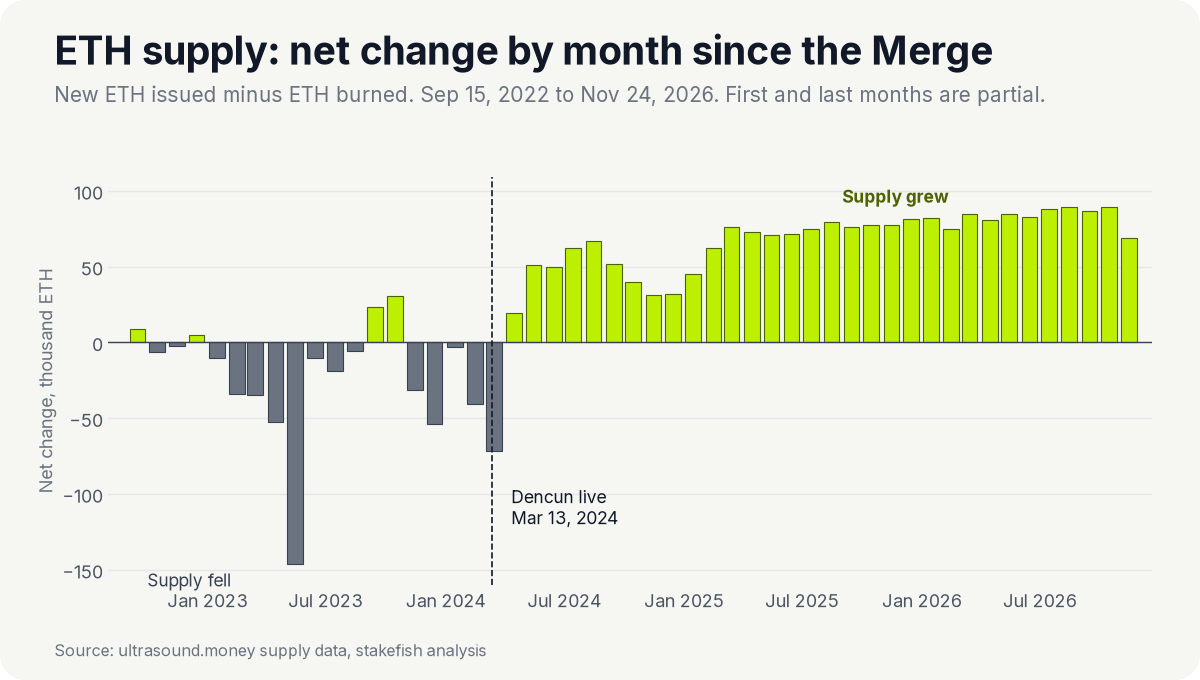
By calendar year:
- 2023: -343,992 ETH (-0.29%)
- 2024: +287,903 ETH (+0.24%)
- 2025: +865,618 ETH (+0.72%)
- Past 12 months to November 24, 2026: +1,008,951 ETH (+0.83%)
The burn has not stopped. It has shrunk next to issuance. Since the Merge, ultrasound.money counts 2.02M ETH burned against about 3.75M ETH issued, so the burn offset 54%. In the last 30 days, it offset 3.7%.
How the amount staked sets the ETH staking rate
The consensus specs pay each validator a base reward per ETH of effective balance. That reward divides by the square root of all active stake (Altair beacon chain spec, get_base_reward_per_increment, with BASE_REWARD_FACTOR = 64 in the Phase 0 spec).
Two results follow:
- The rate falls as stake grows. Each staked ETH earns less when more ETH stakes.
- Total issuance rises as stake grows. It scales with the square root of total stake, so supply growth rises with it.
With today's 44.42M ETH and every validator doing every duty, the protocol would issue 1.106M ETH a year. That is a maximum rate of 2.49% on stake and 0.90% of supply. Actual issuance over the last 30 days came to 98.8% of that maximum.
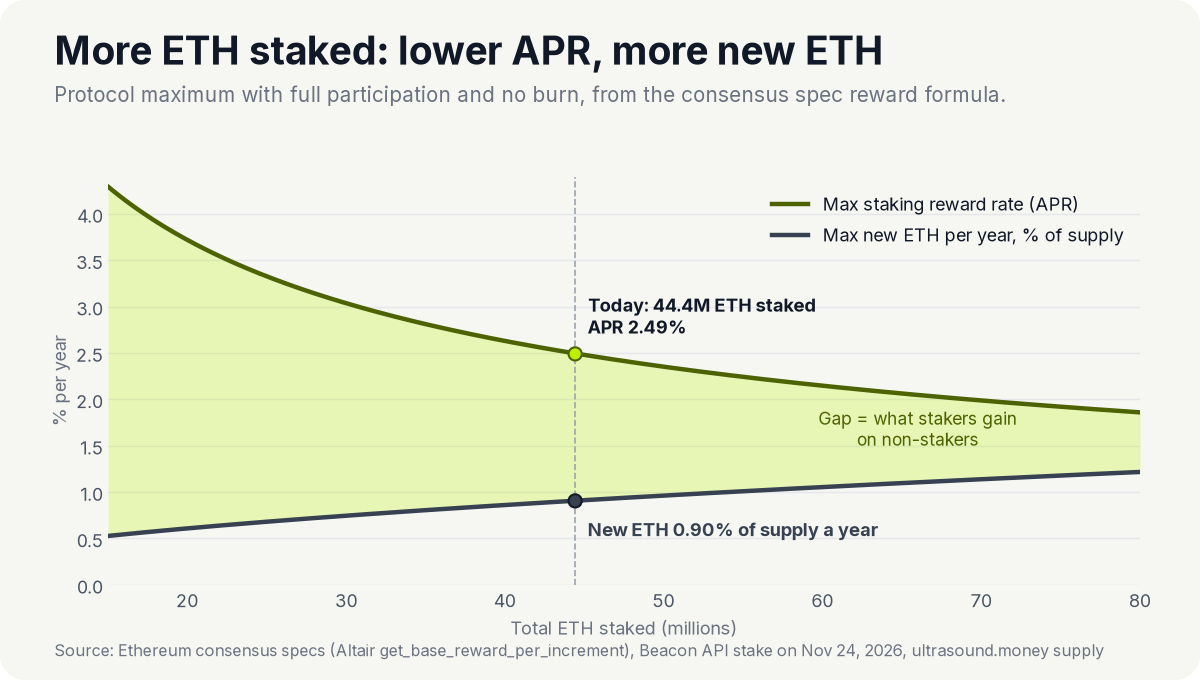
| Total ETH staked | Max staking APR | Max new ETH a year |
|---|---|---|
| 30M | 3.04% | 0.91M ETH |
| 44.4M (today) | 2.49% | 1.11M ETH |
| 60M | 2.15% | 1.29M ETH |
| 80M | 1.86% | 1.49M ETH |
The gap between the two lines is what stakers gain on non-stakers before the burn. It narrows as more ETH stakes. The rate beats supply growth at every level in the chart.
What moves ETH real yield from here
- New stake. 717,621 ETH sat in the entry queue on November 24, 2026 (validatorqueue.com). If all of it activates, the maximum rate drops from 2.49% to 2.48%. Our staking queues study tracks how fast new stake arrives.
- Onchain demand. A higher burn lowers supply growth and lifts real yield for stakers. In 2023, the burn turned supply negative.
- Execution layer rewards. Priority fees and MEV go to block proposers. They rise with onchain activity. See MEV-Boost relays in 2026.
- Validator performance. Missed duties earn less than the maximum. Over short windows, block luck moves results (why 30-day APR misleads).
What ETH real yield means for institutions
- Unstaked ETH carries a cost. At today's pace, an unstaked position loses 0.85% of its network share each year. That applies to treasuries, funds and ETF shares that hold ETH without staking it. Our who stakes ETH study shows which treasuries and ETFs stake.
- Judge rates against supply growth. A 2.5% rate is about 1.6% to 1.7% in share terms today. Use the real figure when you compare ETH staking to other uses of the asset.
- Compare net rates on a neutral basis. Operator commission and validator performance both shape the rate you keep. Neutral sources such as Rated measure performance across operators.
- Keep custody. Native staking keeps ETH under your own withdrawal address. That address can trigger an exit itself under EIP-7002.
Stake ETH with stakefish
stakefish has run validators since 2018 and was a founding node operator for Lido. stakefish is SOC 2 Type II certified for its non-custodial staking services. You stake from your own wallet with no account, and the withdrawal address stays yours.
For platforms, the stakefish Multi-Chain Staking API and SDK add native staking to your product (API and SDK launch).
- Stake ETH with stakefish
- Talk to us about institutional staking
- Read the stakefish API docs
Methodology
- Supply and burn. ultrasound.money supply series and burn totals, read November 24, 2026 at 12:57 UTC (6:57 a.m. CT), block 26,485,164. The 30-day window runs from October 25, 2026, 13:00 UTC. Issuance = supply change + burn.
- Burn cross-check. We summed base fee times gas used for the last 7,200 blocks from a public Ethereum RPC: 121.6 ETH. ultrasound.money showed 123.5 ETH burned over the past day, which includes blob fees.
- Stake. All active validators (active_ongoing and active_exiting) from the head beacon state via a public beacon node, November 24, 2026, around 7:00 a.m. CT. The rate uses effective balance.
- Rates. Annualized with 365.25 days. Real yield = (1 + rate) / (1 + supply growth) - 1. Maximum issuance = 225 epochs a day × 365.25 × 64 × √(total active balance in gwei), in gwei.
- Monthly chart. Supply at 00:00 UTC on the first day of each month. Supply since the Merge starts at 00:00 UTC on September 15, 2022.
Frequently asked questions
What is the real yield on ETH staking?
About 1.59% a year over the 30 days to November 24, 2026. Staking issued 2.46% a year on staked ETH, and ETH supply grew 0.86% a year. With execution layer rewards added, it sits near 1.7%.
Is ETH inflationary in 2026?
Yes, at a low rate. ETH supply grew 0.83% over the 12 months to November 24, 2026, and has grown every month since April 2024. It fell 0.29% in 2023, when the burn was higher.
Why does the ETH staking APR fall when more ETH is staked?
The consensus specs divide each validator's base reward by the square root of all active stake. More stake lowers the reward per ETH, while total issuance rises with the square root of stake.
How much ETH is burned today?
ultrasound.money counted 3,298 ETH burned in the 30 days to November 24, 2026, against 89,781 ETH issued. Since the Merge, it counts 2.02M ETH burned.
Does holding ETH without staking lose value?
Not in ETH count. Your balance stays the same. Your share of total supply falls as new ETH goes to stakers: 0.85% a year at the pace of the last 30 days.
Sources
Facts checked November 24, 2026.
- ultrasound.money supply and burn data
- Ethereum Beacon APIs
- validatorqueue.com
- ethereum.org: The Merge and ETH supply
- Ethereum consensus specs: Altair beacon chain
- Ethereum consensus specs: Phase 0 beacon chain
- EIP-1559: Fee market change
- EIP-4844: Shard blob transactions
- Ethereum Foundation: Dencun mainnet announcement
- Rated
- stakefish: How Ethereum staking rewards work
- stakefish: ETH staking queues, 12 months of data
- stakefish: Who stakes ETH now
Building staking into a platform? The stakefish Multi-Chain Staking API and SDK cover Ethereum, Solana and more. Read the API docs.
Stake ETH with stakefish: stake.fish/ethereum
About stakefish
Founded in 2018 by Ethereum and Bitcoin veterans, stakefish is the leading validator for Proof of Stake blockchains. With support for 10+ networks, we combine institutional‑grade infrastructure with intuitive dashboards, transparent reporting, and a spotless slashing record so individuals and institutions alike can stake confidently while strengthening decentralized networks.
Visit our website 🐠 | Telegram | X | YouTube | LinkedIn