ETH staking queues: 12 months of data
The ETH entry queue peaked at 4.10M ETH and 71 days in Feb 2026. Staked ETH rose 8.0M in 12 months. What the queues show and how to plan around them.

+8.0M ETH. That is how much staked ETH grew from Oct 19, 2025 to Oct 19, 2026: from 36.1M to 44.1M, per validatorqueue.com.
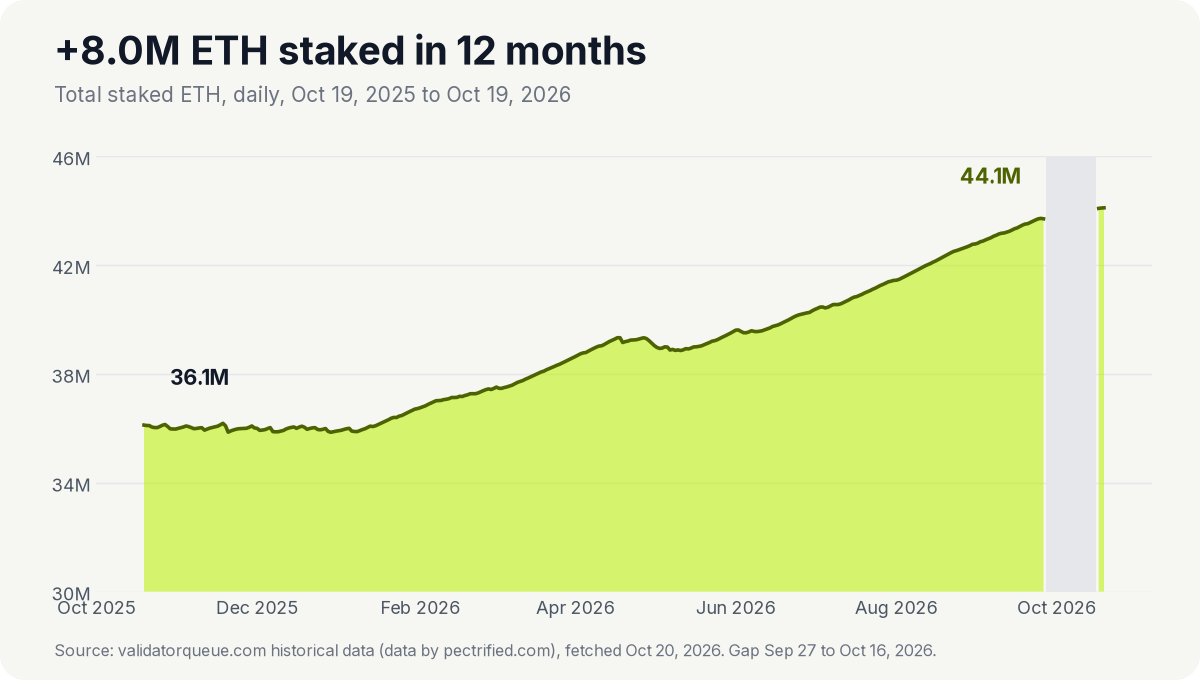
Meaning: for most of the past year, more ETH wanted in than out, and the protocol made it wait.
How the queues work
To start or stop staking on Ethereum, a validator joins a queue. The protocol limits how much ETH can enter or exit per epoch (6.4 minutes, per ethereum.org). This limit is called churn.
Since the Electra upgrade, the cap for activations and exits is 256 ETH per epoch (consensus spec, MAX_PER_EPOCH_ACTIVATION_EXIT_CHURN_LIMIT). There are 225 epochs per day, so:
- 256 ETH × 225 = 57,600 ETH per day can enter
- 57,600 ETH per day can exit
The wait in days is the queue size divided by 57,600. A 4.10M ETH entry queue means 4,103,856 / 57,600 = 71.2 days.
Churn exists to keep the validator set stable. Large, fast swings in stake would weaken the security guarantees of proof of stake.
Twelve months in four phases
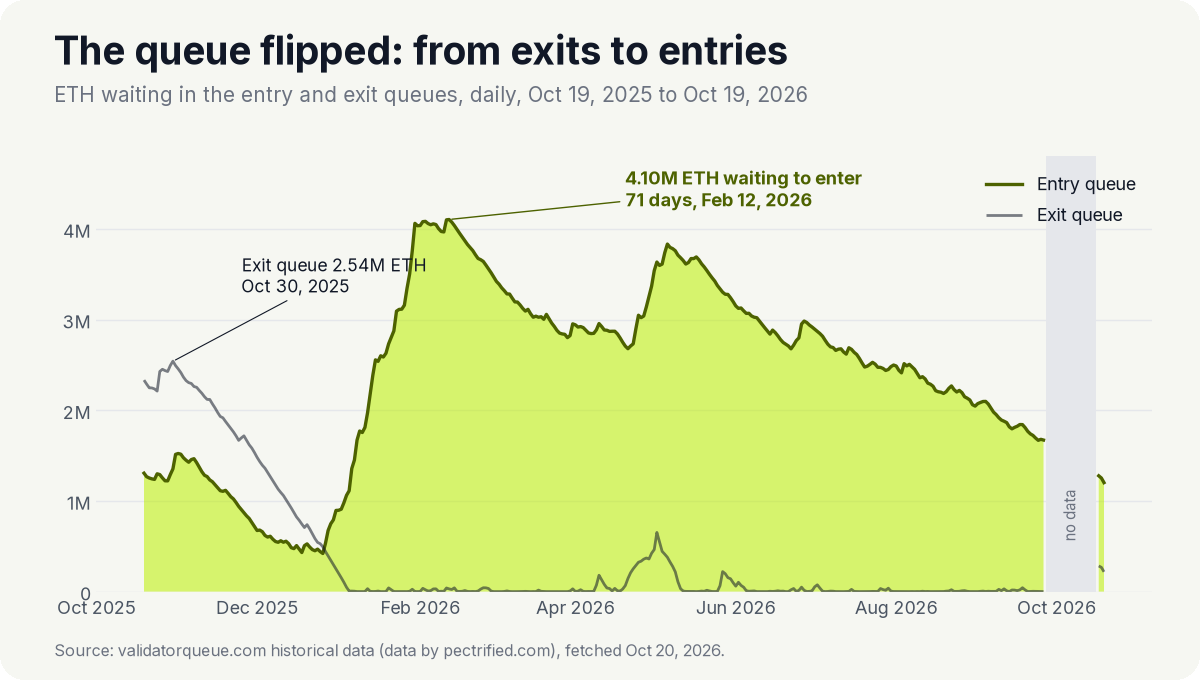
All figures below come from validatorqueue.com's historical data (data by pectrified.com), fetched Oct 20, 2026.
1. Exit-heavy (Oct to Dec 2025). On Oct 19, 2025, 2,332,651 ETH sat in the exit queue with a 40.5-day wait. The entry queue held 1,306,075 ETH. The exit queue peaked in our window on Oct 30, 2025 at 2,541,694 ETH, a 44.3-day wait.
2. The flip (Dec 27, 2025). Exits drained. On Dec 27, the entry queue (533,138 ETH) passed the exit queue (441,809 ETH). It has stayed above it every day since.
3. The entry wave (Jan to May 2026). The entry queue rose to its peak on Feb 12, 2026: 4,103,856 ETH and a wait of about 71 days. It eased, then climbed again to 3,833,175 ETH on May 6 (66.8 days). For 256 of the 346 days with data, the entry wait was longer than 30 days.
4. Slow drain (Jun to Oct 2026). The entry queue fell to 1,201,604 ETH by Oct 19, 2026, a 20.8-day wait. The exit queue stood at 218,053 ETH, a 4.9-day wait. The staked share of supply rose from 29.8% to 36.1% over the year.
Note: validatorqueue.com has no daily data from Sep 27 to Oct 16, 2026. The chart shows the gap.
Who was in the line
The data does not name the ETH in each queue. Public filings show large holders that began or grew staking in this window:
- BitMine reported 5,067,309 ETH staked as of Oct 18, 2026 (8-K exhibit).
- Grayscale's Ethereum ETFs began staking on Oct 6, 2025 (10-K).
- iShares Staked Ethereum Trust ETF (ETHB) reported 250,585 ETH staked on June 30, 2026 (10-Q).
We cannot match these to queue days. See our post on who stakes ETH now for the full breakdown.
Today's queues
The live page on Oct 23, 2026 showed:
| Queue | ETH waiting | Wait | Churn |
|---|---|---|---|
| Entry | 1,368,318 | 24 days, 4 hours | 256 ETH per epoch |
| Exit | 12,950 | 1 day, 7 hours | 256 ETH per epoch |
| Consolidation | 580,972 | 6 days, 7 hours | 348 ETH per epoch |
The exit wait is not the full time to get ETH back. After a validator exits, the network sweeps its balance to the withdrawal address. Validatorqueue.com showed a sweep delay of 7.1 days on Oct 23.
Consolidation is new since Electra. It merges several 32 ETH validators into one larger validator, up to 2,048 ETH (consensus spec). It has its own churn lane.
What changes next: EIP-8061
Glamsterdam, Ethereum's next upgrade, includes EIP-8061. Per ethereum.org:
- Activations keep their existing cap.
- Exits are no longer capped. Exit churn scales with total ETH staked.
- Consolidations get their own capacity, close to half the size of the combined activation-exit limit.
At current staking levels, ethereum.org estimates exit capacity rises 4x and consolidation capacity 2x. The trade-off: the weak subjectivity period, how long a node can stay offline before it needs a trusted checkpoint, falls from 15.7 days to about 7 days.
Glamsterdam is live on the Sepolia testnet. Its Hoodi date of Oct 26, 2026 was postponed on Oct 22, and no new date is set. The mainnet date is not set either (EF blog). Until then, the 256 ETH per epoch cap applies.
How to plan around the queues
- Check the queue before you commit capital. A 70-day entry wait is 70 days of no rewards on that ETH. Price it in.
- Plan exits in two parts. Exit queue time, then sweep time. On Oct 23 that was 1.3 days plus 7.1 days.
- Watch the direction, not one print. The queue flipped from exits to entries in two months. It can flip back.
- Consider consolidation. Fewer, larger validators mean fewer keys to manage. Consolidations use their own lane and do not wait behind exits.
Bottom line
For most of the past year, entering Ethereum staking took over a month. The entry queue peaked at 4.10M ETH and 71 days in February 2026. On Oct 23 it was 1.37M ETH and 24 days. Exits are fast today, and EIP-8061 would make them faster once Glamsterdam reaches mainnet.
For institutions: the stakefish Multi-Chain Staking API and SDK supports the full Ethereum deposit flow, with 0x01 and 0x02 withdrawal credentials and batch validator creation of up to 100 at once. Read the API docs or request access.
Sources
- validatorqueue.com, live page (Oct 23, 2026) and historical data (fetched Oct 20, 2026), data by pectrified.com
- Ethereum consensus specs, Electra beacon chain (churn limits)
- ethereum.org, Glamsterdam (EIP-8061)
- Ethereum Foundation, Glamsterdam on Hoodi Postponed (Oct 22, 2026)
- BitMine Immersion Technologies, 8-K Exhibit 99.1 (Oct 19, 2026)
- Grayscale Ethereum Staking ETF, Form 10-K for 2025
- iShares Staked Ethereum Trust ETF, Form 10-Q for Q2 2026
- stakefish Multi-Chain Staking API and SDK launch post
Building staking into a platform? The stakefish Multi-Chain Staking API and SDK cover Ethereum, Solana and more. Read the API docs.
Stake now at: stake.fish/stake
About stakefish
Founded in 2018 by Ethereum and Bitcoin veterans, stakefish is the leading validator for Proof of Stake blockchains. With support for 20+ networks, we combine institutional‑grade infrastructure with intuitive dashboards, transparent reporting, and a spotless slashing record so individuals and institutions alike can stake confidently while strengthening decentralized networks.
Visit our website 🐠 | Telegram | X | YouTube | LinkedIn