How Ethereum staking rewards work: EL vs CL after Pectra
How consensus and execution rewards work on Ethereum, why the EL share fell after Pectra, what Glamsterdam may change, and how to read a staking report.

Most staking dashboards show one number: APR. That number is a sum. Behind it sit two reward streams from two parts of the protocol. They have different sources, different timing and different destinations.
If you mix them up, validator performance is hard to read. A month with a low APR can come from a validator that did every duty well but proposed no block. A month with a high APR can come from one large MEV payment that says nothing about the operator.
This guide covers how each stream works today, after the Pectra upgrade. It covers why the execution-layer share fell, what Glamsterdam may change next, and how to read a staking report. For the basics, see our 2022 post, Ethereum Consensus and Execution Layer Rewards.
The architecture: two layers, two reward sources
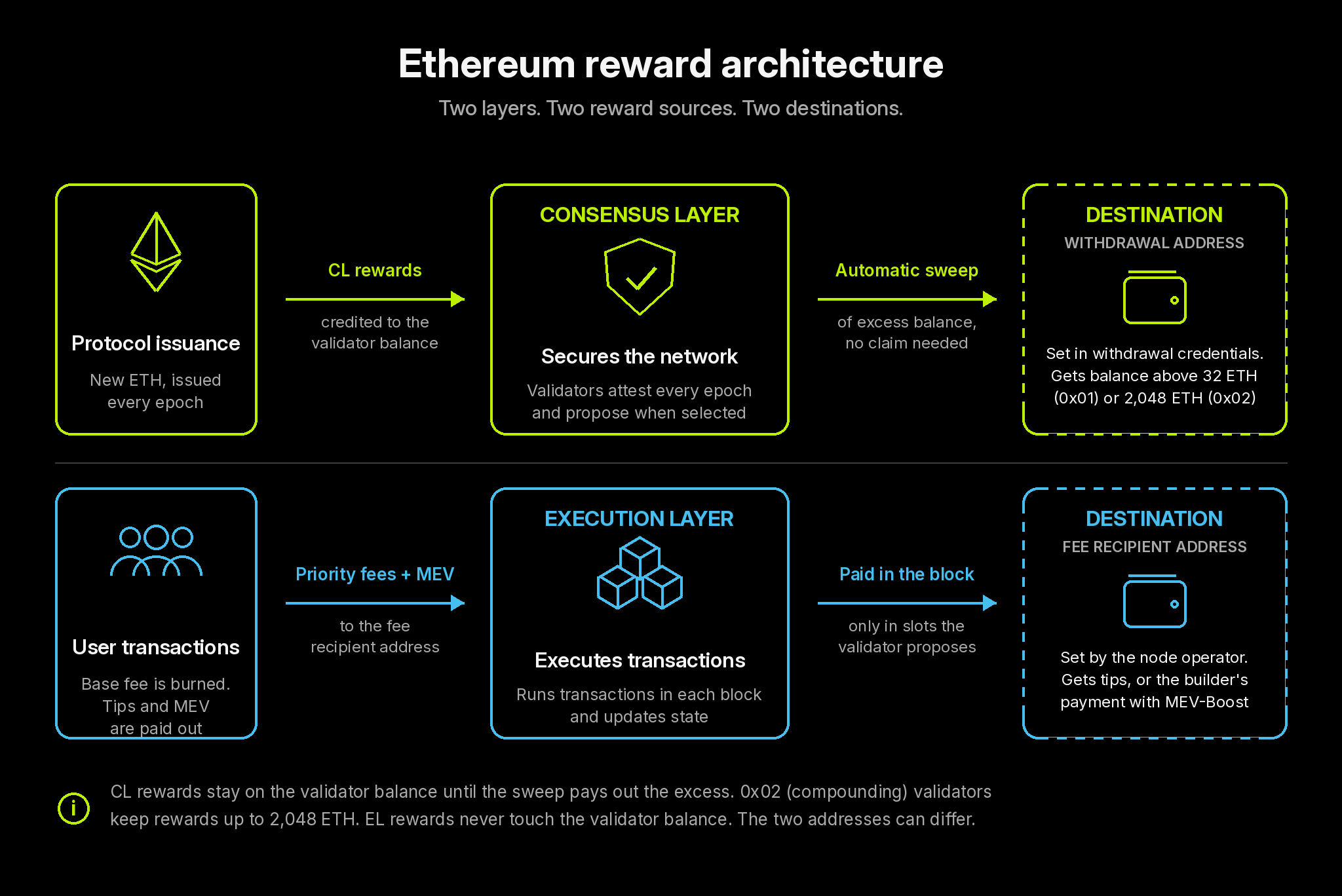
Ethereum runs on two layers. The consensus layer (CL) is the beacon chain and its validators. They agree on the state of the chain. The execution layer (EL) runs transactions and smart contracts. Since the Merge in September 2022, one set of staked validators runs both.
A simple way to think about it: CL rewards are a salary. The protocol pays them on a fixed schedule for doing the job. EL rewards are a commission. Users and traders pay them, and the amount depends on demand for block space.
CL rewards are new ETH, issued by the protocol. EL rewards are existing ETH, moved from users to validators.
Consensus-layer rewards: the predictable part
CL rewards pay validators for the duties that keep the chain in agreement. The protocol applies all rewards and penalties once per epoch: 32 slots of 12 seconds, about 6.4 minutes (ethereum.org).
The four parts of CL income
Attestations. Every epoch, each active validator votes on its view of the chain. The vote has three parts: the source checkpoint, the target checkpoint and the head block. A timely, correct vote earns a reward for each part. A missed source or target vote costs the same amount it would have paid. A missed head vote earns nothing but carries no penalty.
Block proposals. In each slot, the protocol picks one validator at random to propose the block. The odds scale with effective balance. The proposer earns a CL reward for the attestations and sync committee signatures it includes. A proposer can earn a reward for including proof that another validator broke the rules. This is a whistleblower reward.
Sync committees. Every 256 epochs (about 27 hours), the protocol picks 512 validators. They sign each new block header so light clients can follow the chain without a full node. Pay per epoch is high while it lasts, but selection is rare.
Avoiding penalties. The protocol does not pay for this, but it matters. If the chain stops finalizing for more than four epochs, an inactivity leak starts. Validators that are offline lose stake until the chain finalizes again. In normal conditions, this costs nothing. It is the reason uptime and client diversity matter.
How CL rewards split
The consensus specs give each duty a fixed weight out of 64:
| Duty | Weight | Share of CL rewards |
|---|---|---|
| Source vote | 14 | 21.9% |
| Target vote | 26 | 40.6% |
| Head vote | 14 | 21.9% |
| Block proposer | 8 | 12.5% |
| Sync committee | 2 | 3.1% |
At full participation, attestations pay 84.4% of CL rewards. Proposals pay 12.5%. Sync committees pay 3.1%.
What sets the CL rate
The base reward scales with a validator's effective balance and falls with the square root of all staked ETH. More stake means more total issuance, but less per ETH staked. This is by design.
On October 20, 2026, ethereum.org showed 43,948,738 ETH staked, 35% of supply, and a network APR of 2.5% (ethereum.org/staking). ultrasound.money estimated issuance at 0.413 ETH per slot, about 1.09M ETH per year (ultrasound.money).
Where CL rewards land
CL rewards add to the validator's balance on the beacon chain. The protocol then sweeps the excess to the withdrawal address set in the validator's withdrawal credentials. No claim is needed.
- With 0x01 credentials, every ETH above 32 is swept out.
- With 0x02 (compounding) credentials, rewards stay on the balance up to 2,048 ETH. They count toward effective balance, so they earn rewards too. Only the part above 2,048 ETH is swept.
The Pectra upgrade added 0x02 credentials and raised the maximum effective balance from 32 to 2,048 ETH. Pectra went live on May 7, 2025.
How CL rewards behave
CL rewards arrive every epoch. For a validator with good uptime, they vary little from week to week. Proposals and sync committees add some noise, but attestations dominate. CL rewards do not depend on how busy the chain is.
Execution-layer rewards: the variable part
EL rewards are not new ETH. Users and traders pay them. A validator earns them only in slots where it proposes a block.
The three parts of EL economics
Priority fees. Under EIP-1559, every transaction pays a base fee and an optional tip. The tip goes to the block's fee recipient. Users raise tips to get included faster, so tips rise when the chain is busy.
MEV. Maximal extractable value is value from including, excluding or ordering transactions in a block. Examples are DEX arbitrage and liquidations. Searchers find these trades and send bundles to block builders. Builders pay the proposer for the right to build the block.
The base fee burn. This is not a payment to validators. The base fee is burned and leaves the supply. It shapes ETH supply, not validator income. Over the 30 days to October 20, 2026, ultrasound.money counted 2,425 ETH burned.
How EL rewards are captured: MEV-Boost
Most validators sell their block space through MEV-Boost, an optional sidecar to the validator client. The flow:
- Searchers find MEV trades and send bundles to builders.
- Builders compete to assemble the most valuable block.
- Builders send bids to relays. Relays hold the block and pass the best bid to the proposer.
- The proposer signs the block header. The relay publishes the full block. The builder pays the proposer's fee recipient in the same block.
The builder's bid already includes the priority fees in the block. That is why this post treats tips and MEV as one stream in the charts.
Over September 20 to October 20, 2026, relays delivered at least 83% of slots in our sample. The relays that reported the most deliveries were ultra sound, Titan and Aestus. Flashbots and ETHGas round out the five relays in our sample. bloXroute relays returned no data to our queries, so our numbers leave them out.
A validator that does not run MEV-Boost builds its own blocks from the public mempool. It earns priority fees but misses MEV that goes to specialized builders.
How EL rewards behave
Lumpy timing. On October 20, 2026, a beacon node reported 43,759,743 ETH of active effective balance. A validator with 32 ETH of effective balance had a 32 / 43,759,743 chance to propose in each slot. That is 1.92 proposals per year, or one about every 190 days.
Skewed size. In the same 30-day window, the median relay payment was 0.0089 ETH. The mean was 0.0218 ETH, 2.5 times the median. The largest single payment was 614 ETH. A few blocks carry much of the value.
For a single validator, a 7-day or 30-day APR says more about luck than about the operator. A smoothing pool spreads that luck across many validators.
The split in 2026
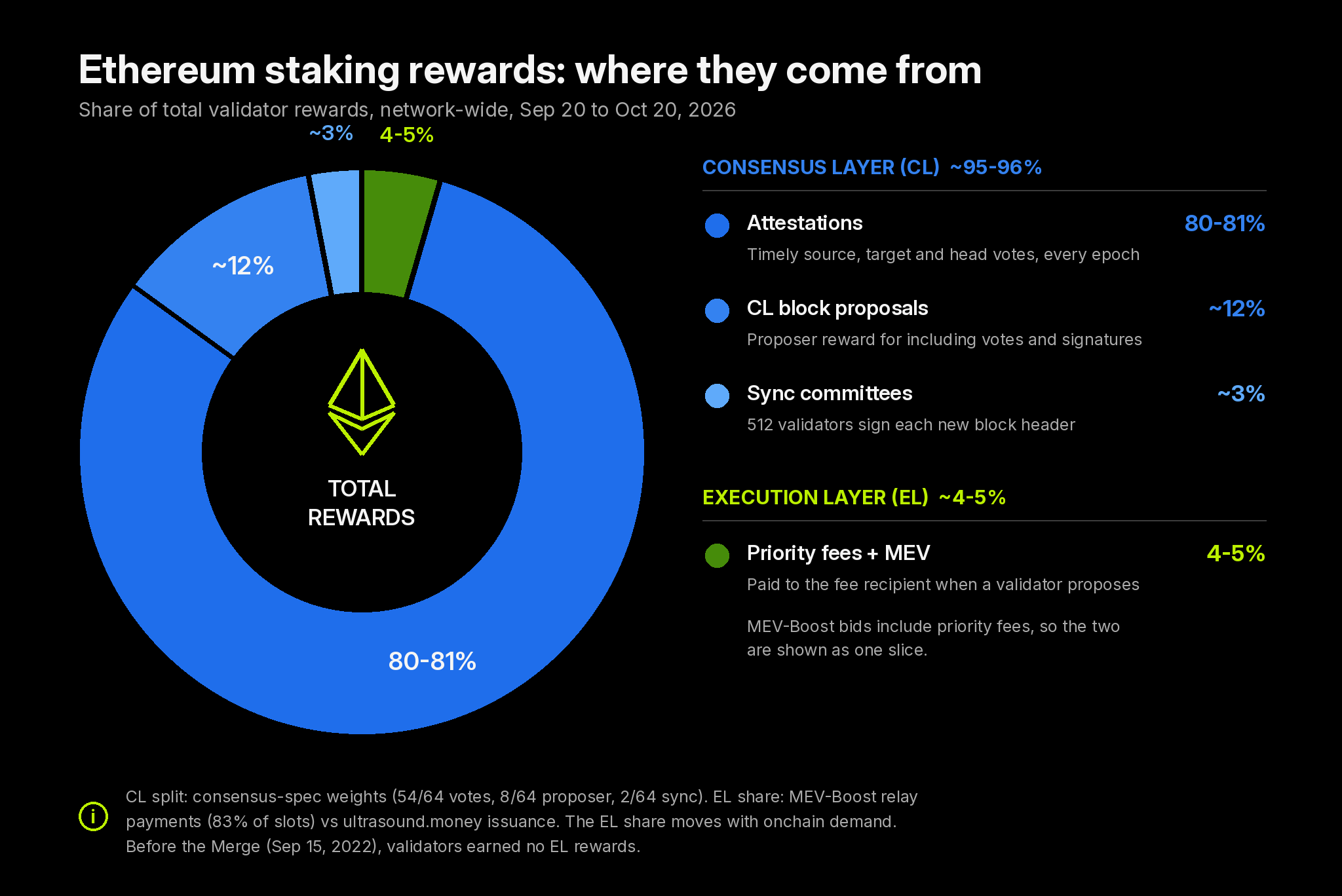
For September 20 to October 20, 2026, we compared the two streams across the whole network. The five relays in our sample paid proposers 3,928 ETH across 83% of slots. Scaled to all slots, that is about 4,700 ETH. Issuance over the same 216,000 slots was about 89,000 ETH at the ultrasound.money rate.
| Component | Share of total rewards | Driver |
|---|---|---|
| CL attestations | 80% to 81% | Uptime, timely votes |
| CL block proposals | about 12% | Random proposer selection |
| CL sync committees | about 3% | Random committee selection |
| EL priority fees and MEV | 4% to 5% | Onchain demand, MEV-Boost |
The CL rows apply the spec weights to the CL share. The EL row counts relay payments only (4.2%) or scales them to all slots (5.0%).
Why the EL share fell after Pectra
The EL share is lower today than before Pectra. We measured it with the same method across four windows. For each window, we took the mean relay payment per delivered block and scaled it to all slots. We set that against issuance from the spec formula at full participation, using staked ETH from validatorqueue.com.
| Window | ETH staked | Mean relay payment | EL share of rewards |
|---|---|---|---|
| Apr 30 to May 7, 2025 (week before Pectra) | 34.3M | 0.0340 ETH | 8.4% |
| Aug 1 to 8, 2025 | 36.1M | 0.0277 ETH | 6.8% |
| Jan 12 to 19, 2026 | 36.1M | 0.0141 ETH | 3.6% |
| Sep 20 to Oct 20, 2026 | 43.8M | 0.0218 ETH | 5.0% |
Two things moved. Payments per block fell: the mean in January 2026 was less than half the pre-Pectra level. And stake grew by about 9.5M ETH, which raised total issuance. Both push the EL share down.
Pectra did not change how priority fees or MEV reach the fee recipient. The timing lines up with Pectra, but the data points to smaller block payments and more stake.
These are short windows. One week can swing with a single large MEV event. Treat the table as a trend, not a monthly series.
Where operators add or subtract value
The protocol sets what is on offer. What a staker receives depends on what the operator captures.
CL: operational levers
- Effectiveness. This is the share of attestation duties done right and on time. In February 2026, stakefish posted 99.70% effectiveness against 98.32% for the network (The State of Ethereum in 2026). Small gaps add up over a year on large stake.
- Client diversity. If a client with more than two thirds of stake has a bug, the network could finalize a faulty chain. Running minority clients lowers that risk.
- Slashing record. Slashing burns stake and removes the validator. The record is either clean or it is not.
- Redundancy. Many regions, redundant infrastructure and audited controls such as SOC 2 cut single points of failure.
EL: capture levers
- Relay diversity. More relays bring more builder bids. One relay means one point of failure.
- Fee recipient setup. EL rewards go to the fee recipient, not the withdrawal address. A wrong setting means lost income.
- Smoothing pools. A pool spreads proposal luck across many validators, so income is steadier.
- Compliance posture. Relays differ in what they filter. Stakers with regulatory needs should know which relays their operator uses.
How Glamsterdam may change the picture
Glamsterdam is the next Ethereum upgrade. It combines the Amsterdam execution-layer upgrade with the Gloas consensus-layer upgrade. It does not change the two-stream model. It may change how EL rewards flow.
Enshrined proposer-builder separation (ePBS), EIP-7732. Forkcast lists it as scheduled for Glamsterdam and as a headline feature. The EF blog explains the change: a proposer includes a builder's commitment to a payload, then the builder reveals it. The protocol handles payment to the proposer. That reduces reliance on trusted middleware. A new payload timeliness committee attests to whether the builder revealed its payload on time. The EF asks validator operators to review the new duties before the upgrade.
Block-level access lists, EIP-7928, and the gas limit. Forkcast lists BALs as scheduled too. Sepolia moved to a 200M gas limit at its Glamsterdam fork. Hoodi's fork, and its move to 200M, was postponed on October 22 (EF blog). Mainnet today runs at 60M. No mainnet gas limit for Glamsterdam has been set.
Timing. Glamsterdam went live on Sepolia on October 6, 2026. The Hoodi fork set for October 26 was postponed on October 22 while developers study how EIP-8037 interacts with existing contracts, and no new date is set. The mainnet date has not been decided. Forkcast says the rollout is paused while a security disclosure is analyzed (Forkcast).
What this means for EL rewards is still open. More gas per block could mean more fees per block, but that depends on demand. We will update this guide once mainnet details are final.
What good staking reports look like
A good staking report should:
- Split rewards. Show CL and EL apart, not one APR.
- Use more than one window. Show 7-day, 30-day and longer windows, and compare them with the network.
- Show operations. Effectiveness, missed attestations, missed proposals and slashing events should be easy to find.
- Make EL rewards checkable. If there is a smoothing pool, its address and flows should be public onchain.
- Name the relays. Relay choice affects EL capture and compliance.
What this means for stakers
- Judge over longer windows. Week-to-week swings are normal. They come from proposal luck and MEV, not from the operator.
- Look at the parts, not only the total. CL effectiveness shows how well the operator runs validators. EL capture shows how it handles block building.
- Expect change. The EL share has moved a lot since Pectra. Glamsterdam will change how builders and proposers trade. The way to evaluate an operator stays the same.
Stake Ethereum with stakefish
stakefish has run Ethereum validators since the beacon chain launched in 2020, with SOC 2 controls and zero slashing (stake.fish). You can stake ETH with stakefish, or build staking into your product with the stakefish Multi-Chain Staking API and SDK. The API docs show how to track CL and EL rewards per validator.
Sources
- ethereum.org, Proof-of-stake rewards and penalties, Staking, Pectra, MEV
- Ethereum consensus specs, Altair and Electra
- ultrasound.money issuance and burn data, Oct 20, 2026
- validatorqueue.com staked ETH history
- MEV-Boost relay data APIs: ultra sound, Titan, Aestus, Flashbots, ETHGas
- Forkcast: Glamsterdam and EF blog, Glamsterdam Hoodi announcement and Hoodi postponement
Building staking into a platform? The stakefish Multi-Chain Staking API and SDK cover Ethereum, Solana and more. Read the API docs.
Stake now at: stake.fish/stake
About stakefish
Founded in 2018 by Ethereum and Bitcoin veterans, stakefish is the leading validator for Proof of Stake blockchains. With support for 20+ networks, we combine institutional‑grade infrastructure with intuitive dashboards, transparent reporting, and a spotless slashing record so individuals and institutions alike can stake confidently while strengthening decentralized networks.
Visit our website 🐠 | Telegram | X | YouTube | LinkedIn