Glamsterdam audits: which Ethereum contracts could break under EIP-8037 and EIP-8038
The EF's highest estimate is that Glamsterdam's gas repricing affects up to 15,000 of about 90 million Ethereum contracts. What EIP-8037 and EIP-8038 change, which contracts break, who needs to act, and what it means for ETH stakers.

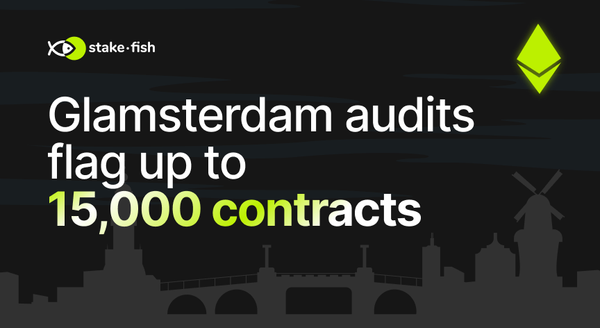
15,000. That is the upper estimate of Ethereum contracts that could be affected by Glamsterdam's new gas rules, out of about 90 million contracts on Ethereum. Marius van der Wijden of the Ethereum Foundation gave the range, 10,000 to 15,000, on the All Core Devs testing call of November 16, 2026. He called it the highest estimate, not a confirmed count (ACDT #103 summary, transcript).
That is less than 0.02% of contracts. It is enough to hold up the upgrade. The Hoodi testnet fork has been on hold since October 22, and core developers plan to make the go/no-go call on November 26 for a Hoodi fork in the week of December 14, with December 16 or 17 as candidate dates.
Here is what Glamsterdam changes, which contracts break and why, who has to act, and what it means if you stake ETH.
Quick answer
- What changes. EIP-8037 makes creating new state 5 to 8 times more expensive in gas. EIP-8038 raises the cost of reading and writing existing state.
- What breaks. Contracts and bots that hard-code a gas amount, keep a fixed gas reserve, or measure gas with two
gasleft()readings. - How many. 10,000 to 15,000 contracts, by the highest EF estimate. ChainSecurity reported 152 findings. Combined with the EF's internal search and the EF-coordinated investigations, the assessment covers 200 findings: 3 High, 30 Medium, 167 Low and none Critical (ACDT #103, ChainSecurity).
- When. Hoodi is penciled for the week of December 14, with December 16 or 17 as candidate dates. The go/no-go is All Core Devs Consensus call #192 on November 26. Mainnet is mid-January 2027 at the earliest if the spec stays as written. No date is final (ACDE #249).
- For stakers. The EF says no action is required from mainnet users or ETH holders for the Hoodi delay (EF). If you hold staked ETH through a smart contract protocol, watch for its Glamsterdam notice.
What is Glamsterdam?
Glamsterdam is Ethereum's next network upgrade. It combines the Amsterdam execution layer upgrade with the Gloas consensus layer upgrade. Its headline changes are enshrined proposer-builder separation (ePBS, EIP-7732) and block-level access lists (BALs, EIP-7928). Both change how blocks are built and checked, to support higher throughput on Ethereum (EF testnet announcement).
It went live on the Sepolia testnet on October 6, 2026, at 13:53:36 UTC (EF). The Hoodi testnet fork, set for October 26, was postponed on October 22 so developers could study how EIP-8037 interacts with mainnet contracts (EF). Our Glamsterdam explainer for institutional stakers covers the full upgrade. Our ePBS guide covers what changes for MEV rewards.
What EIP-8037 and EIP-8038 change
Both EIPs reprice state. State is the data every Ethereum node keeps: account balances, contract code and storage. More state makes nodes slower and costlier to run.
EIP-8037: state creation. The EIP sets one price per new byte of state, called CPSB, at 1,530 gas. It targets average state growth of 120 GiB a year at a reference gas limit of 150M. It meters state gas apart from normal gas, so blocks can hold more work and larger contracts (EIP-8037).
The EIP gives the reason in numbers. In January 2026, the state in a Geth node took about 390 GiB. After the gas limit rose from 30M to 60M, new state per day more than tripled, from about 105 MiB to about 326 MiB. Nodes start to slow down near 650 GiB. At a 200M gas limit and that pace, state would cross that line in less than a year (EIP-8037).
EIP-8038: state access. The EIP raises the cost of a cold account access from 2,600 to 3,000 gas. It adds a storage write charge of 10,000 gas and an account write charge of 9,000 gas. It says wallets and RPC methods such as eth_estimateGas must update their gas math (EIP-8038).
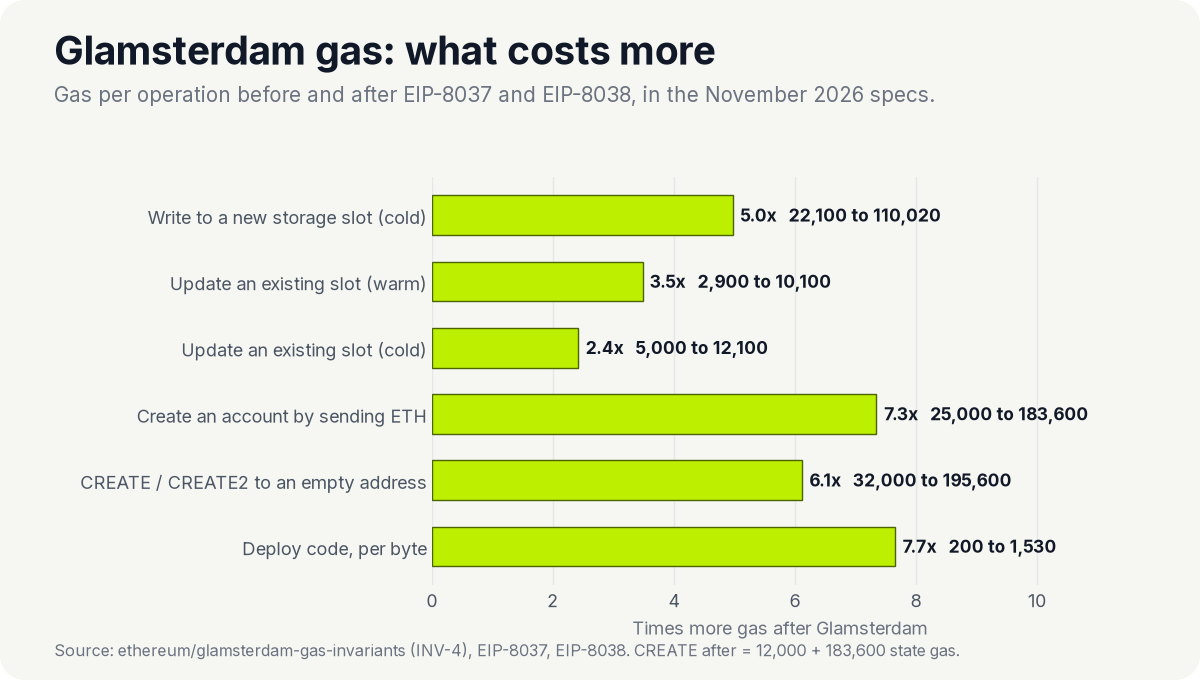
| Operation | Gas today | Gas after Glamsterdam |
|---|---|---|
| Write to a new storage slot, cold | 22,100 | 110,020 (97,920 of it state gas) |
| Update an existing slot, warm / cold | 2,900 / 5,000 | 10,100 / 12,100 |
| Create an account by sending ETH to an empty address | 25,000 | 183,600 of state gas plus execution |
| CREATE / CREATE2 to an empty address | 32,000 | 12,000 + 183,600 of state gas |
| Deploy code | 200 per byte | 1,530 per byte |
Source: INV-4 in the EF's invariants repository.
Why some Ethereum contracts break under Glamsterdam
Most contracts do not care what gas costs. They forward all remaining gas and let the transaction sender pay. The ones at risk made an assumption about gas that Glamsterdam changes. The EF lists eight of these assumptions, called invariants, in a public repository for auditors (ethereum/glamsterdam-gas-invariants). Some break because prices go up. Others break because EIP-8037 tracks state gas in a new way.
Fixed gas amounts that are no longer enough (INV-4)
Any gas amount fixed before the fork may be too small after it. That includes amounts written into a contract, its settings, a signed message or off-chain software. The most common case is a first-time recipient. Sending a token to an address with a zero balance creates a new storage slot. The EF says "a transfer that fits in 65,000 gas today can need over 150,000" (INV-4).
Where the fixed amount lives decides the damage. In a relayer or bot, the transaction reverts and gets resent with more gas. Inside a contract, such as a bridge's minimum destination gas or a callback budget, the inner call fails. If the outer contract catches the failure, the result can stick: a message stored as failed, a callback skipped, rewards booked wrong.
Gas reserves and stipends sized for today (INV-7)
Some contracts keep back a fixed amount of gas to record a result after a call. Recording a result can write a new slot, which goes from 22,100 to 110,020 gas. The 2,300 gas stipend that transfer and send pass along cannot create a storage slot at all after the fork. A receiving contract that writes a new slot needs over 110,000 (INV-7).
New accounting rules from the state gas reservoir
EIP-8037 keeps state gas in a separate reservoir when a transaction's gas limit is above 224, or 16,777,216. Below that, all state gas comes out of normal gas. The reservoir changes some old rules. Gas left can go up during a call. A reverting call can hand back the state gas it used. Code that bills users by subtracting two gasleft() readings can get a wrong or negative result. EIP-8037 says deployed contracts with that kind of metering "cannot be fixed" (invariants repository, EIP-8037).
How many contracts are affected?
Four sources looked at the question in November 2026:
- EF estimate. 10,000 to 15,000 contracts at the highest estimate, out of about 90 million. Van der Wijden put the value in contracts that had not committed to an upgrade at a few hundred thousand dollars, and said he had no reliable numbers on it (ACDT #103 transcript).
- ChainSecurity. The EF engaged ChainSecurity to assess the impact. On the November 16 call, ChainSecurity reported 152 findings of its own, 76 of which overlapped with the EF's internal search, for 200 in total. Its public report, completed November 18, covers those 200 findings with the EF-coordinated work: 3 High, 30 Medium, 167 Low, none Critical. 24 need a contract upgrade or migration. Most can be fixed with a configuration change (ChainSecurity).
- Dedaub. The EF engaged Dedaub for a second study. Its search for contracts with non-trivial gas patterns that had received transactions in the prior six months returned about 25,000 contracts (ACDT #103 transcript).
- EF outreach. The EF reported outreach to over 50 affected companies by November 19 (ACDE #249).
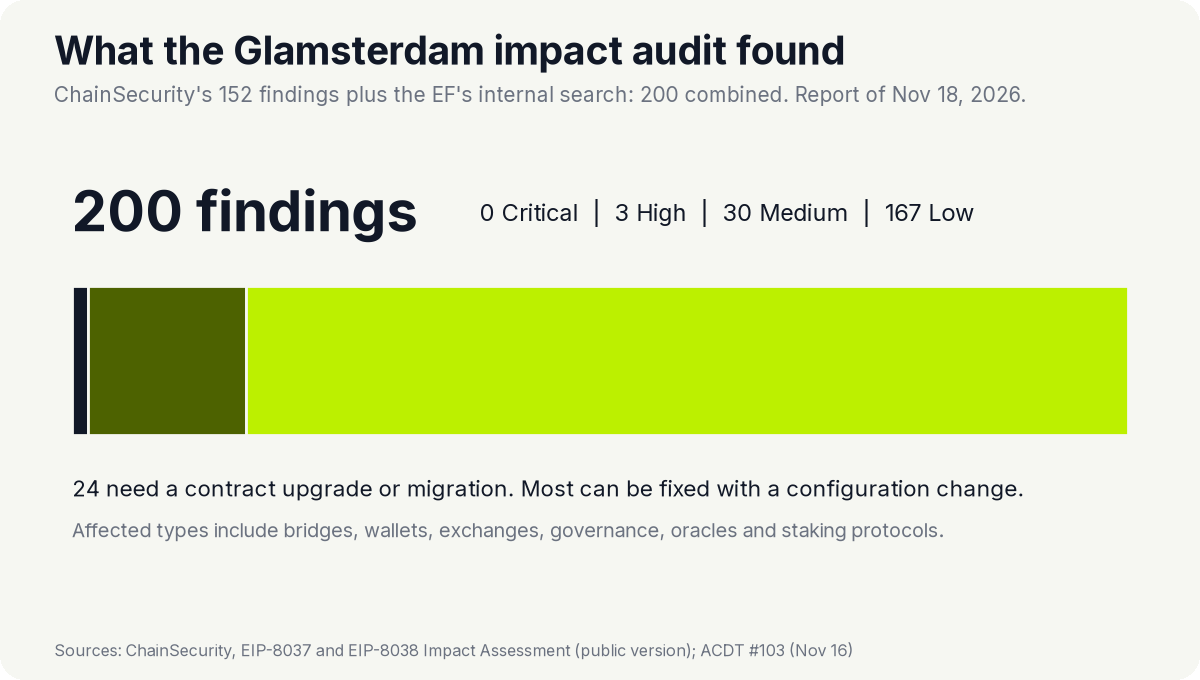
ChainSecurity lists the types of affected systems: bridges and messaging systems, wallets, exchanges, governance, oracles, staking protocols and off-chain services. Possible outcomes range from interrupted operations to locked funds and reward-accounting errors. It adds that no assessment can find every affected system.
Who needs to act before Glamsterdam
| Who | What to do | Source |
|---|---|---|
| Contract developers and auditors | Check code against the eight invariants. Report issues to glamsterdam@ethereum.org. | EF blog |
| Wallets and RPC providers | Update gas estimation, including eth_estimateGas, for the new costs. | EIP-8038 |
| Relayers, keepers, bridges and bots | Make fixed gas limits adjustable. Estimate under the new rules and add a margin. | INV-4 |
| Node and validator operators | Update execution and consensus clients once a fork date and client releases are announced. | EF |
| ETH holders and native stakers | No action for the Hoodi delay. Watch for official mainnet dates. | EF |
What Glamsterdam means for ETH stakers
Native stakers. You do not need to do anything about the gas changes. The EF says the Hoodi postponement requires no action from mainnet users or ETH holders (EF). Your operator handles client upgrades before each fork.
Liquid staking and restaking users. Staking protocols are on ChainSecurity's list of affected system types. That does not mean a given protocol is affected. If you hold a staking token, look for that protocol's Glamsterdam statement before mainnet (ChainSecurity).
Validator duties. Glamsterdam's ePBS adds new duties and changes how MEV payments flow. Under EIP-7732, the builder pays the proposer from its own staked balance. The EIP makes no change to how the protocol issues new ETH. See our ePBS and MEV rewards guide.
Timing. The longer the testing, the later mainnet. Developers chose to delay the fork rather than ship with open questions about deployed contracts.
Glamsterdam timeline: what happens next
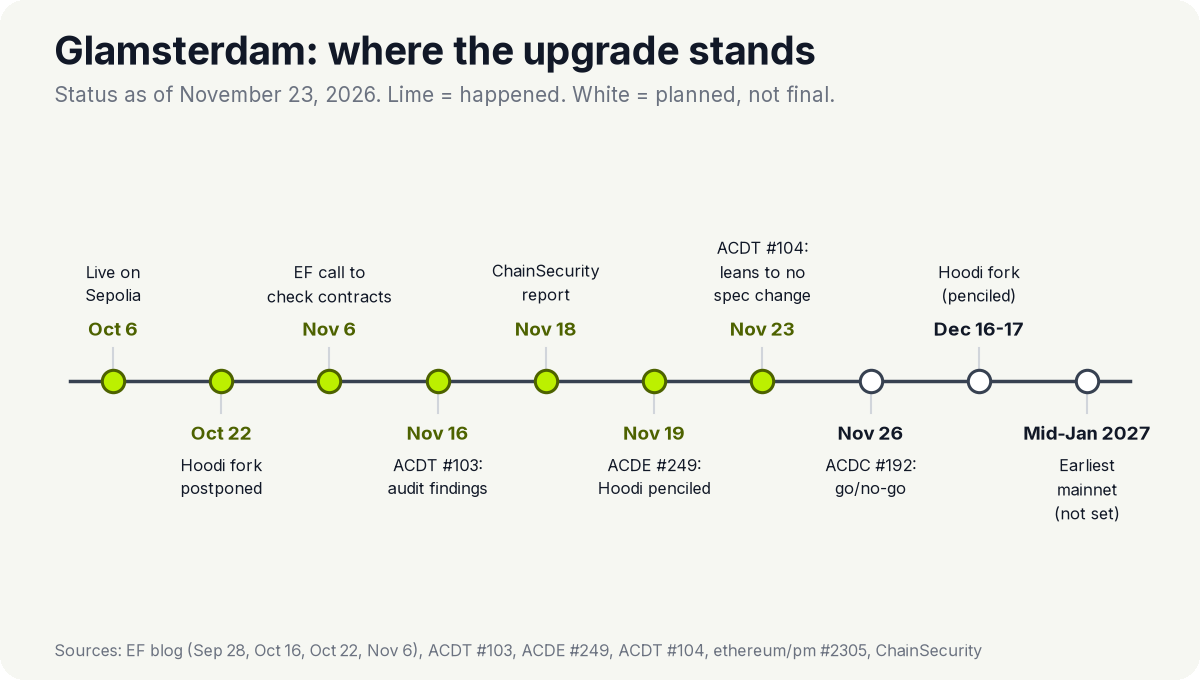
- November 19, ACDE #249. The official summary records "a rough consensus to proceed with the current Glamsterdam spec unless a viable alternative emerged." The call penciled a Hoodi fork for the week of December 14, with December 16 or 17 as the candidate dates. Developers who want a spec change were given a week to prepare the case (ACDE #249).
- November 23, ACDT #104. Developers reviewed a decision tree of possible EIP-8037 changes. Per the summary, the group "leaned towards not changing the spec at this time." Rahul (EF) relayed team feedback that most high and medium severity issues are expected to be addressed by mid-January (ACDT #104).
- November 26, ACDC #192. All Core Devs Consensus meets at 14:00 UTC (8:00 a.m. CT), with Glamsterdam first on the agenda (ethereum/pm #2305). It is the go/no-go for the Hoodi date. A yes would lock in the current spec (ACDE #249).
- December 16 or 17. Penciled Hoodi fork. Not final.
- Mid-January 2027. The earliest mainnet date from the EF's outreach, if the spec does not change. Not scheduled.
We cover each call in the stakefish newsletter and on our blog, including the Hoodi date, the audit pause and the deposit bug fix.
Stake ETH with stakefish
stakefish has run Ethereum validators since the Beacon Chain launched in 2020 and was a founding node operator for Lido. stakefish is SOC 2 Type II certified for its non-custodial staking services. You stake from your own wallet, and the withdrawal address stays yours.
stakefish charges 0% commission on consensus-layer rewards and retains 50% of execution-layer rewards, including priority fees and MEV (how our commission works).
- Stake ETH with stakefish
- Talk to us about institutional staking
- Read the stakefish API docs
Frequently asked questions
What is EIP-8037?
EIP-8037 is a Glamsterdam proposal that raises the gas cost of creating new state on Ethereum. It sets 1,530 gas per new byte of state and meters state gas apart from normal gas, targeting about 120 GiB of state growth a year at a 150M gas limit.
How many contracts could Glamsterdam affect?
The highest Ethereum Foundation estimate is 10,000 to 15,000 contracts out of about 90 million. ChainSecurity reported 152 findings of its own. Combined with the EF's internal search and the EF-coordinated investigations, its public assessment covers 200 findings: 3 High, 30 Medium, 167 Low and none Critical, with 24 needing a contract upgrade or migration.
When is the Glamsterdam mainnet upgrade?
No mainnet date is set. On November 19, 2026, developers penciled a Hoodi testnet fork for the week of December 14, with December 16 or 17 as candidate dates and the go/no-go on November 26. The EF's outreach pointed to mid-January 2027 as the earliest mainnet date if the spec does not change.
Do ETH stakers need to do anything for Glamsterdam?
Native stakers and ETH holders do not need to act on the gas changes. Operators update clients before each fork. Holders of liquid staking or restaking tokens should check their protocol's Glamsterdam notice.
Why does Glamsterdam change gas costs?
State growth is a limit on scaling. EIP-8037 says new state per day more than tripled after the gas limit rose from 30M to 60M. Higher prices for creating and touching state keep node hardware needs in check as gas limits rise.
Sources
Facts checked November 23, 2026.
- EIP-8037: State Creation Gas Cost Increase
- EIP-8038: State-Access Gas Cost Update
- ethereum/glamsterdam-gas-invariants (INV-4, INV-7)
- Ethereum Foundation: EIP-8037/EIP-8038 Glamsterdam, November 6, 2026
- Ethereum Foundation: Glamsterdam on Hoodi Postponed, October 22, 2026
- Ethereum Foundation: Glamsterdam Testnet Announcement, September 28, 2026
- Ethereum Foundation: Glamsterdam Hoodi Testnet Announcement, October 16, 2026
- EIP-7732: Enshrined Proposer-Builder Separation
- All Core Devs Testing #103, November 16, 2026 and transcript
- All Core Devs Execution #249, November 19, 2026
- All Core Devs Testing #104, November 23, 2026
- ethereum/pm #2305: ACDC #192, November 26, 2026
- ChainSecurity: EIP-8037 and EIP-8038 Impact Assessment
- stakefish: Glamsterdam explained
- stakefish: ePBS and your MEV rewards
- stakefish: Ethereum gas limit history
Stake ETH with stakefish: stake.fish/ethereum
Want analysis like this every week? Subscribe to the stakefish newsletter.
About stakefish
Founded in 2018 by Ethereum and Bitcoin veterans, stakefish is the leading validator for Proof of Stake blockchains. With support for 10+ networks, we combine institutional‑grade infrastructure with intuitive dashboards, transparent reporting, and a spotless slashing record so individuals and institutions alike can stake confidently while strengthening decentralized networks.
Visit our website 🐠 | Telegram | X | YouTube | LinkedIn