ETH staking ETF fees: why the same ETH earns different rewards
Grayscale ETHE and the Ethereum Mini ETF stake the same ETH with the same custodian. One keeps 77% of gross staking rewards, the other 94%. Here is what the SEC filings show about where the gap comes from.
77% vs 94%. That is the share of gross staking rewards each of Grayscale's two ETH staking ETFs keeps. The figures come from each fund's Form 10-Q for the quarter ended September 30, 2026, filed November 5 (ETHE 10-Q, ETH Mini 10-Q).
Same sponsor. Same custodian. Same network. Same start date for staking. One fund gives up 23% of its gross staking rewards in fees. The other gives up 6%.
Here is what the filings and fund pages show, where the gap comes from, how a second fee layer changes the result, and what institutions should ask before they choose a way to earn ETH staking rewards.
Quick answer
- The cut. Grayscale Ethereum Staking ETF (ETHE) keeps 77% of gross staking rewards. Grayscale Ethereum Staking Mini ETF (ticker ETH) keeps 94%. The rest goes to the sponsor, the custodian and the staking providers combined.
- The rates. On November 20, 2026, Grayscale's fund pages showed 2.71% gross (before staking fees) and 2.54% net (after all staking fees) for the Mini, and 2.68% gross and 2.06% net for ETHE. Both rates cover staked ETH, not the whole fund, and neither is net of the management fee (ETH, ETHE).
- The second layer. Each fund charges a yearly management fee on all its assets: 0.15% for the Mini and 2.50% for ETHE.
- The result. In the first nine months of 2026, ETHE booked $27.5M of staking reward income and paid a $33.6M sponsor's fee. The Mini booked $26.7M and paid $2.1M.
- The lesson. The gross rate tells you about the network. The share you keep tells you about the product. Ask for both.
What the Grayscale ETH staking fund pages show
Both funds started staking on October 6, 2025. Both name Coinbase Custody Trust Company as custodian and Anchorage Digital Bank as an available alternative custodian (ETHE 10-Q, ETH 10-Q). Grayscale publishes four staking figures for each fund. These were the figures dated November 20, 2026:
| Measure | ETH (Mini) | ETHE |
|---|---|---|
| Gross staking rewards | 2.71% | 2.68% |
| Net staking rewards | 2.54% | 2.06% |
| Share of fund ETH staked | 84.27% | 79.49% |
| Management fee, per year, on assets | 0.15% | 2.50% |
| Net as a share of gross | about 94% | about 77% |
Sources: Grayscale ETH fund page and Grayscale ETHE fund page, as of November 20, 2026. Grayscale dates each figure on the page, so the live pages may show newer values. The last row is stakefish arithmetic on those figures.
The definitions matter:
- Gross staking rewards are the average rewards the fund earned on its staked ETH over the prior 60 calendar days, annualized on a 360-day calendar.
- Net staking rewards are what the fund receives after all staking fees. Grayscale gives the rate as a percentage of the staked assets, not of the whole fund. It says the figure does not reflect returns at the fund level.
- Staked % is the share of the fund's ETH committed to staking, including ETH waiting in protocol queues.
- Management fee is a yearly fee on all the fund's assets, staked or not. It sits on top of the staking fees.
The two gross rates sit close together. They come from the same network. The net rates do not. The gap between gross and net is the staking fee, and it is set by contract, not by the network.
Where the gap between ETHE and the Mini comes from
Each 10-Q spells out the split in the same words. Here is ETHE: "the Sponsor's Staking Fee, the Custodian's fee and the applicable staking providers' share comprise an aggregate of 23% of gross Staking Consideration generated under the Trust's staking arrangements, with the remainder retained by the Trust" (ETHE 10-Q). The Mini's 10-Q uses the same sentence with 6% (ETH 10-Q).
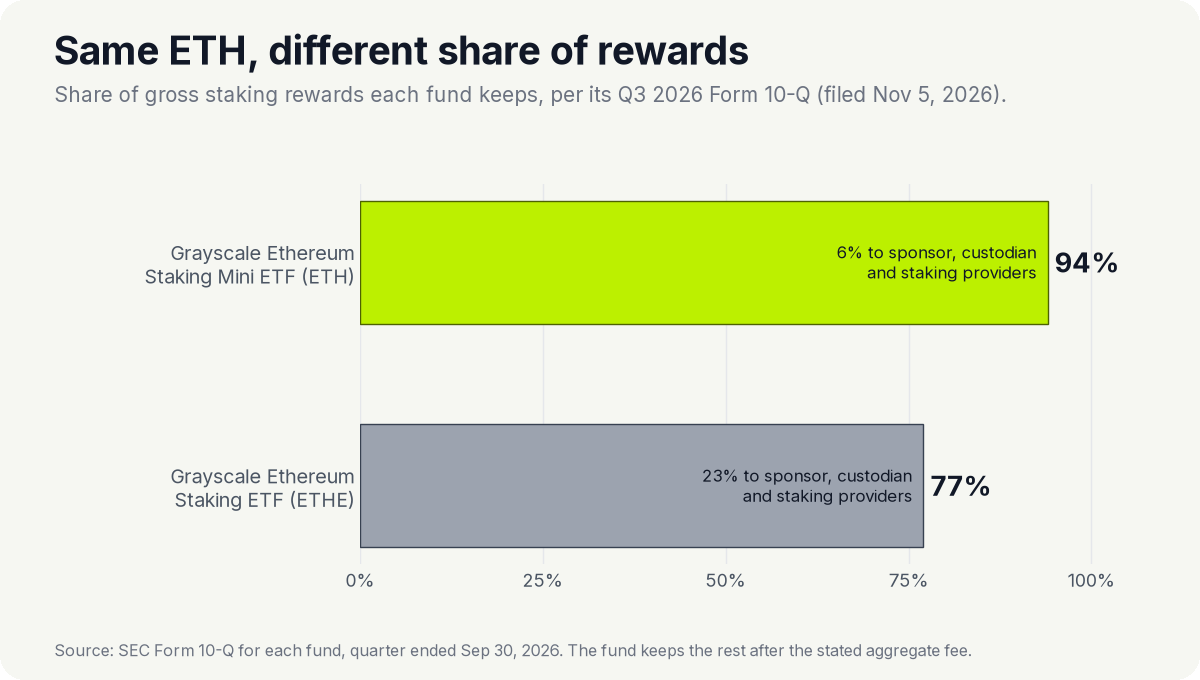
Three parties share that cut:
- The staking providers. They run the validators. The funds' 2025 annual reports call them third-party staking providers that "may be affiliates of the Custodian or other trusted institutional validators" (ETHE 10-K, ETH 10-K).
- The custodian. Coinbase Custody Trust Company holds the ETH and takes a fee from staking rewards.
- The sponsor. Grayscale takes a Sponsor's Staking Fee, which the 2025 annual reports describe as "consideration for the Sponsor's facilitation of Staking" (ETHE 10-K, ETH 10-K).
The filings give the total, not the split between the three. They do not name the staking providers either. ETHE's 2025 annual report adds that each staking provider must be "unrelated to both the Trust and the Sponsor" and bears its own costs (ETHE 10-K). Our staking ETF provider map tracks which US ETH and SOL staking products name their providers and which do not.
The check works on the November 20, 2026 page figures. 94% of the Mini's 2.71% gross rate is 2.55%, close to the 2.54% net it reports. 77% of ETHE's 2.68% gross rate is 2.06%, the net it reports.
Two layers of fees: staking fees and management fees
The staking fee comes out of rewards. The management fee comes out of everything. That second layer is where the two funds split the most.
The 10-Q statements of operations show both layers for the nine months to September 30, 2026:
| Nine months to Sep 30, 2026 | ETHE | ETH (Mini) |
|---|---|---|
| Staking reward income (net of validator fees) | $27.468M | $26.705M |
| Sponsor's fee (management fee on assets) | $33.618M | $2.101M |
| Sponsor's staking fee | $5.664M | $0.826M |
Source: Statements of Operations in the ETHE 10-Q and ETH 10-Q, amounts in thousands of US dollars in the filings.
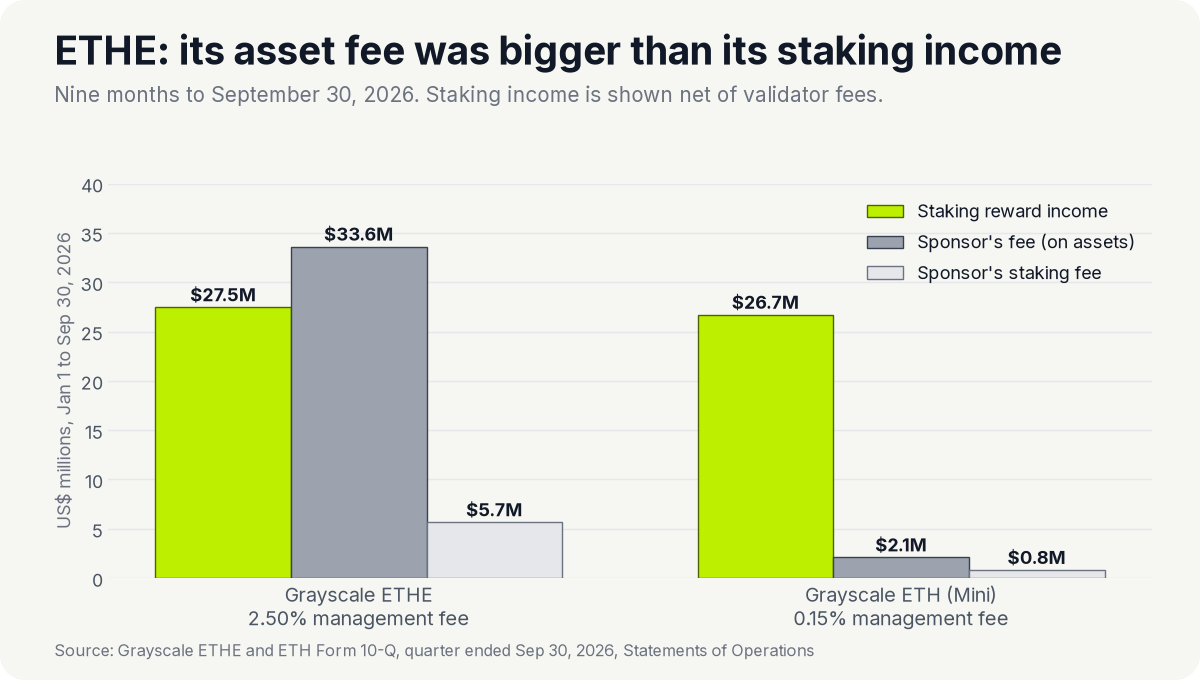
For ETHE, the management fee was larger than the staking income. Staking softened the fee. It did not cover it. For the Mini, staking income was more than twelve times the management fee.
Worked example: 1,000 ETH of exposure for a year
Take the November 20 page figures and hold them flat for a year. This is a simple model, not a forecast and not a fund return.
| Per 1,000 ETH of exposure | ETH (Mini) | ETHE |
|---|---|---|
| ETH staked | 842.7 ETH | 794.9 ETH |
| Net staking rewards on staked ETH | +21.4 ETH | +16.4 ETH |
| Management fee on all assets | -1.5 ETH | -25.0 ETH |
| Net change before price | +19.9 ETH | -8.6 ETH |
Assumptions: staked share, net rate and fee hold for 12 months. No compounding. Grayscale annualizes its rates on a 360-day calendar, and we apply them as stated. Both funds pay net staking proceeds out as cash. ETHE's 10-Q lists monthly cash distributions from January 6, 2026 (ETHE 10-Q). The Mini's 10-Q says that effective August 7, 2026, the Trust makes periodic cash distributions (ETH 10-Q). A holder sees part of the staking line as distributions rather than more ETH per share.
The model shows the point of the filings in ETH terms. At ETHE's fee level, staking rewards do not offset the management fee. At the Mini's fee level, they do with room to spare.
Why the gross rates look alike and the net rates do not
Ethereum pays validators by formula. The consensus specs set the base reward per ETH from total active stake, so every validator faces the same schedule. Execution layer rewards, priority fees and MEV, add a smaller and lumpier stream on top. Our EL vs CL rewards guide found priority fees and MEV made up 4% to 5% of total staking rewards from September 20 to October 20, 2026.
Two well-run validator sets should land close on gross rewards over 60 days. Small gaps come from timing, block luck and how much MEV each set captured. Our validator luck study shows why short windows can mislead.
The large gaps come from fees. That is why the 2.71% and 2.68% gross rates, before staking fees, turn into 2.54% and 2.06% net of staking fees (fund pages, November 20, 2026).
What ETH staking ETF fees mean for institutions
If you allocate to ETH through a fund, or run ETH on your own balance sheet, use these questions:
- What share of gross rewards reaches me? Ask for one number that covers the sponsor, the custodian and the operator.
- Is there a fee on assets as well as on rewards? A fee on assets applies to unstaked ETH too.
- How much of the ETH is staked? A fund that stakes 80% of its ETH earns rewards on 80%.
- Who runs the validators? Named operators let you check track record and performance on neutral data such as Rated.
- How are execution layer rewards handled? Priority fees and MEV are lumpy. Ask whether they are pooled and how they are shared.
- What do I get in reporting? Gross, net, staked share and fees, on a fixed schedule.
How native staking with stakefish compares
A fund adds layers: a sponsor, a custodian and an operator, each with a share. With native staking, you keep your ETH, and the withdrawal address stays yours.
stakefish publishes its Ethereum fees. Our Ethereum staking page states: "stakefish charges 0% commission on consensus-layer rewards and retains 50% of execution-layer rewards, including priority fees and MEV."
ETFs serve investors who need a brokerage wrapper. If you hold ETH yourself, native staking lets you check the fee on each reward stream yourself.
Stake ETH with stakefish
stakefish has run validators since 2018 and was a founding node operator for Lido. stakefish is SOC 2 Type II certified for its non-custodial staking services. You stake from your own wallet, and the withdrawal address stays yours.
For platforms, the stakefish Multi-Chain Staking API and SDK add native staking to your product (API and SDK launch).
- Stake ETH with stakefish
- Talk to us about institutional staking
- Read the stakefish API docs
Methodology
- Fee splits. Aggregate staking fee shares (23% for ETHE, 6% for the Mini) from each fund's Form 10-Q for the quarter ended September 30, 2026, signed November 5, 2026.
- Income and fees. Nine-month figures from the Statements of Operations in the same filings. Staking reward income is reported net of validator fees. The sponsor's staking fee is reported as an expense.
- Rates. Gross, net, staked share and management fee from Grayscale's fund pages dated November 20, 2026. Grayscale dates each figure on the page.
- Worked example. Exposure x staked share x net rate, minus exposure x management fee. Flat for 12 months, no compounding, no price change.
Our news brief: Same ETH, different staking rewards: Grayscale Mini vs ETHE
Frequently asked questions
What are the fees on Grayscale ETH staking ETFs?
ETHE gives up 23% of gross staking rewards to its sponsor, custodian and staking providers combined, and charges a 2.50% yearly management fee on assets. The Grayscale Ethereum Staking Mini ETF gives up 6% of gross staking rewards and charges 0.15% a year, per each fund's Q3 2026 Form 10-Q.
Why do ETHE and the ETH Mini report different net staking rewards?
Their gross rates are close because both stake on the same network. ETHE keeps 77% of gross rewards and the Mini keeps 94%, so on November 20, 2026 ETHE showed 2.06% net and the Mini showed 2.54% net.
Did ETHE earn more from staking than it paid in fees?
No. In the nine months to September 30, 2026, ETHE booked $27.5M of staking reward income and paid a $33.6M sponsor's fee, plus a $5.7M sponsor's staking fee, per its 10-Q.
Who runs the validators for Grayscale's ETH staking ETFs?
The funds' filings describe third-party staking providers arranged with the custodian, Coinbase Custody Trust Company, and say each must be unrelated to the trust and the sponsor. The filings do not name them.
What does stakefish charge on Ethereum staking rewards?
Our Ethereum staking page states: "stakefish charges 0% commission on consensus-layer rewards and retains 50% of execution-layer rewards, including priority fees and MEV."
Sources
Facts checked November 23, 2026.
- Grayscale Ethereum Staking ETF (ETHE), Form 10-Q, quarter ended September 30, 2026
- Grayscale Ethereum Staking Mini ETF (ETH), Form 10-Q, quarter ended September 30, 2026
- Grayscale Ethereum Staking ETF, Form 10-K for 2025
- Grayscale Ethereum Staking Mini ETF, Form 10-K for 2025
- Grayscale ETHE fund page
- Grayscale ETH fund page
- Rated
- stakefish: How Ethereum staking rewards work, EL vs CL
- stakefish: Staking ETFs, which filings name a provider
- stakefish: Who stakes ETH now
- stakefish: Validator luck
- stakefish Ethereum staking and fees
Stake ETH with stakefish: stake.fish/ethereum
Want analysis like this every week? Subscribe to the stakefish newsletter.
About stakefish
Founded in 2018 by Ethereum and Bitcoin veterans, stakefish is the leading validator for Proof of Stake blockchains. With support for 10+ networks, we combine institutional‑grade infrastructure with intuitive dashboards, transparent reporting, and a spotless slashing record so individuals and institutions alike can stake confidently while strengthening decentralized networks.
Visit our website 🐠 | Telegram | X | YouTube | LinkedIn