MEV-Boost relays in 2026: who delivers Ethereum's blocks
Relay and builder market share from 12 months of data, which relays filter, the bloXroute Max Profit shutdown and what ePBS changes.

Most Ethereum blocks are not built by the validator that proposes them. Builders prepare full blocks and send them to relays. Relays pick the most profitable block and pass it to the proposer (Flashbots docs). Builders and proposers both have to trust the relay in the middle (Flashbots docs).
The relay market changed in 2026. bloXroute shut down its Max Profit relay on August 26 (bloXroute). Aestus took a bigger share. Two builders now build close to three in four MEV-Boost blocks.
We pulled 12 months of daily relay and builder stats, plus one week of block-level data from each relay's public API. Here's who delivers Ethereum's blocks today, which relays filter, and what ePBS changes.
The numbers
From relay data APIs, Oct 22 to 28, 2026 (UTC), stakefish analysis:
- 90.6% of blocks came through MEV-Boost. That is 45,510 of 50,255 blocks.
- 90.6% of those MEV-Boost blocks reached the proposer through more than one relay. That is 41,242 of 45,510.
- 638 ETH went from builders to proposers through MEV-Boost in the week. The median block paid 0.0058 ETH. The mean was 0.0140 ETH.
- 73% of MEV-Boost blocks in October 2026 were built by Titan or Quasar, up from 60% in October 2025 (relayscan.io).
What a relay does
MEV-Boost is open source software a validator runs next to its consensus client to get blocks from outside builders. One MEV-Boost instance can connect to many relays, and the validator proposes the most profitable block it receives (Flashbots docs). Operators add relays to a list with the -relays flag (Flashbots docs).
The relay carries trust in two directions. Builders trust it for fair payload routing. Proposers trust it for block validity, accuracy and data availability (Flashbots docs). Anyone can run a relay. Each operator picks which ones its validators trust.
A validator that skips MEV-Boost builds its own block from the public mempool. Flashbots says that path pays less (Flashbots FAQ).
Relay market share: two ways to count it
Relay dashboards count payload deliveries. When the same block reaches the proposer through three relays, all three get credit. relayscan.io shows each relay's share of deliveries this way (relayscan.io).
That number hides how much overlap there is. We pulled every delivered payload from each relay's data API for one week and matched them by slot.
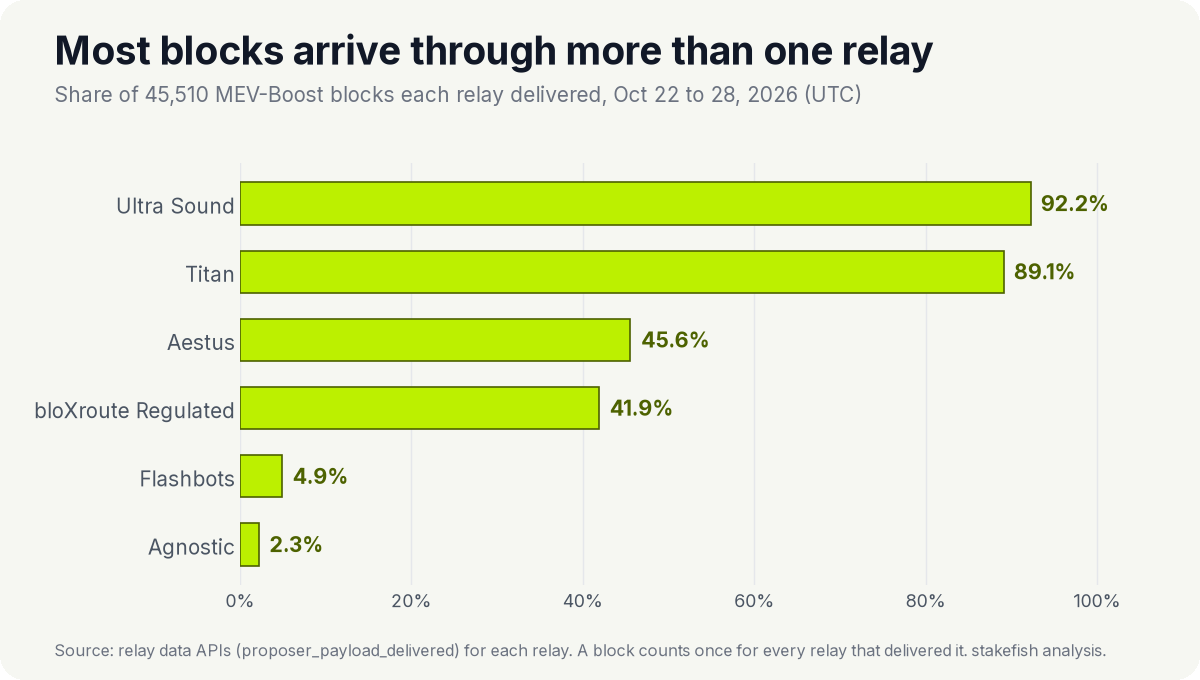
Ultra Sound delivered 92.2% of MEV-Boost blocks in the week. Titan delivered 89.1%. Builders send the same block to many relays, and a validator connected to several relays gets the winning bid from more than one. Nine in ten blocks reached the proposer through two or more relays.
So a relay with 33% of deliveries is not a relay that 33% of the chain depends on. For most blocks, if one of the big two relays failed, the other carried the same block.
How relay share moved in 12 months
Share of payload deliveries by month, from relayscan.io daily stats (relayscan.io):
| Relay | Oct 2025 | Jul 2026 | Sep 2026 | Oct 2026 (to Oct 28) |
|---|---|---|---|---|
| Ultra Sound | 31.6% | 28.6% | 32.0% | 33.5% |
| Titan | 15.7% | 20.5% | 29.7% | 31.9% |
| Aestus | 4.7% | 7.6% | 9.1% | 16.3% |
| bloXroute Regulated | 13.4% | 18.0% | 25.3% | 15.6% |
| bloXroute Max Profit | 25.0% | 20.4% | 0% | 0% |
| Flashbots | 3.9% | 2.4% | 2.2% | 1.7% |
| Agnostic | 4.2% | 1.6% | 0.8% | 0.8% |
Three shifts stand out.
bloXroute Max Profit is gone. bloXroute announced on August 25 that it would shut down the relay on August 26. It said it would keep running its regulated relay "to better serve institutional users" (bloXroute). Lido's Relay Maintenance Committee told node operators to remove it the same day (Lido research forum). Its last deliveries on relayscan.io are on August 26. A year ago it delivered one in four payloads.
Titan doubled. Titan's relay went from 15.7% of deliveries in October 2025 to 31.9% in October 2026. It now sits level with Ultra Sound.
Aestus grew in October. Aestus went from 9.1% in September to 16.3% in October. In the same months, bloXroute Regulated fell from 25.3% to 15.6%.
Builders are more concentrated than relays
Relays pass blocks along. Builders decide what goes in them. relayscan.io groups blocks by the builder name in each block's extra data (relayscan.io).
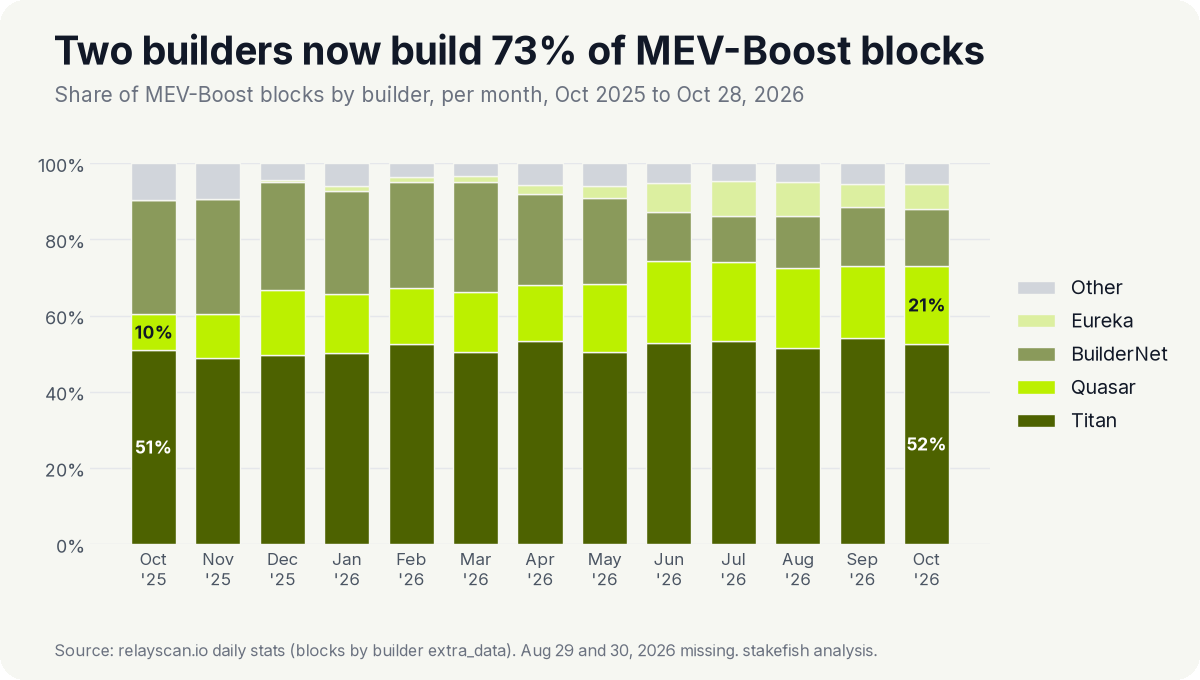
- Titan built 50.8% of MEV-Boost blocks in October 2025 and 52.4% in October 2026. It stayed between 48.8% and 54.1% in every month.
- Quasar rose from 9.6% to 20.6%.
- BuilderNet fell from 29.8% to 15.0%. Most of that drop came in June 2026, when it went from 22.5% to 12.9%.
- Eureka went from 0.1% to 6.5%, with a peak of 9.4% in July 2026.
Titan runs a builder and a relay. Both are the largest or close to it in their market.
Filtering and non-filtering relays
Some relays drop blocks that include transactions from addresses on the OFAC sanctions list. Others pass any valid block. Lido's vetted relay list gives the policy for each one (Lido Operator Portal):
| Relay | Filtering (Lido's list) |
|---|---|
| Aestus | No tx filtering |
| Agnostic | No tx filtering |
| Ultra Sound | No tx filtering |
| Ultra Sound Filtering | Filters OFAC sanctioned addresses |
| Titan Global | No tx filtering |
| Titan Regional | Filters all applicable regulations |
| bloXroute Regulated | Filters OFAC sanctioned addresses |
| Flashbots | Filters OFAC sanctioned addresses |
Titan's docs list the same split: Global is non-filtering and Regional is filtering (Titan Relay docs).
Filtering applies to the relay, not the chain. A block a filtering relay rejects can still go out through a non-filtering relay, or the next proposer can include the transaction. For an institution, the choice of relay set is a compliance decision. It should be a written policy, not a default.
What ePBS changes
EIP-7732, enshrined proposer-builder separation (ePBS), moves part of this into the protocol. Builders become staked entities in the beacon state and can stake as little as 1 ETH. The EIP says it "removes the need to use trusted middleware in order to delegate block construction to a builder" (EIP-7732).
The EIP still leaves room for trusted payments, "promises to be fulfilled elsewhere" (EIP-7732). So relays may not go away on day one. What changes is the fallback. A proposer can take a bid paid in protocol from a staked builder without trusting a relay.
EIP-7732 is in Last Call, with a deadline of November 1, 2026 (EIP-7732). ethereum.org lists ePBS in the Glamsterdam upgrade (ethereum.org). Glamsterdam has no mainnet date. Its Hoodi testnet fork was postponed with no new date (Ethereum Foundation). For how ePBS affects your MEV rewards, read ePBS and your MEV rewards. For the full upgrade, read Glamsterdam explained.
What this means for your stake
- Relay choice affects rewards. MEV-Boost takes the best bid from the relays you connect to. A smaller relay set sees fewer bids.
- Relay choice is a compliance choice. Filtering and non-filtering relays apply different rules. Know which ones your validators use.
- Relay lists go stale. bloXroute Max Profit went from 25% of deliveries to zero in under a year. A relay that shuts down returns no bids.
- Builder concentration is the bigger risk. Two builders built 73% of MEV-Boost blocks in October. Relays have overlap. Builders have less.
Questions to ask your staking provider
- Which relays do my validators connect to, and who reviews that list?
- Do you use filtering relays, non-filtering relays or both? Is that a written policy?
- Did you remove bloXroute Max Profit after August 26, 2026?
- What happens if every relay fails during my slot? Do my validators fall back to local block building?
- How will you handle ePBS bids when Glamsterdam ships?
Stake with stakefish
stakefish infrastructure is SOC 2 Type II Certified (stakefish API and SDK launch). Ask us which relays our validators use and how we review that list.
For platforms, the stakefish Multi-Chain Staking API supports 0x01 and 0x02 withdrawal credentials and batch validator creation of up to 100 at once (API and SDK launch). For who stakes ETH today, read Who stakes ETH now.
- Stake ETH with stakefish
- Talk to us about institutional staking
- Read the stakefish API docs
Methodology
- Block-level data. We pulled every row from the
proposer_payload_deliveredendpoint of each relay's data API for slots 15,483,598 to 15,533,997 (Oct 22 to 28, 2026, UTC). Endpoints: relay.ultrasound.money, relay-filtered.ultrasound.money, global.titanrelay.xyz, regional.titanrelay.xyz, aestus.live, bloxroute.regulated.blxrbdn.com, boost-relay.flashbots.net and agnostic-relay.net. Pulled October 29, 2026. - Block count. 50,255 blocks is the gap in block numbers between the first and last MEV-Boost block in the window, plus one.
- Payments. The bid value in each delivered payload, in ETH. One value per block.
- Monthly shares. relayscan.io daily stats from October 1, 2025 to October 28, 2026. Relay share is share of payload deliveries. Builder share is share of blocks, grouped by builder name. relayscan.io returned errors for August 29 and 30, 2026, so those two days are missing.
Sources
Facts checked October 29, 2026.
- Flashbots docs: MEV-Boost introduction
- Flashbots docs: Relays
- Flashbots docs: MEV-Boost usage
- Flashbots docs: MEV-Boost FAQ
- relayscan.io
- Ultra Sound relay data API
- Flashbots relay data API
- bloXroute: Max Profit relay announcement
- Lido research forum: Relay Maintenance Committee update, August 26, 2026
- Lido Operator Portal: MEV-Boost relays
- Titan Relay docs
- EIP-7732: Enshrined Proposer-Builder Separation
- ethereum.org: Glamsterdam
- Ethereum Foundation: Glamsterdam on Hoodi postponed
- stakefish: Multi-Chain Staking API and SDK
Building staking into a platform? The stakefish Multi-Chain Staking API and SDK cover Ethereum, Solana and more. Read the API docs.
Stake now at: stake.fish/stake
About stakefish
Founded in 2018 by Ethereum and Bitcoin veterans, stakefish is the leading validator for Proof of Stake blockchains. With support for 20+ networks, we combine institutional‑grade infrastructure with intuitive dashboards, transparent reporting, and a spotless slashing record so individuals and institutions alike can stake confidently while strengthening decentralized networks.
Visit our website 🐠 | Telegram | X | YouTube | LinkedIn