NoisyTCP (CVE-2026-99288): what Solana validators need to know and how to patch
NoisyTCP (CVE-2026-99288) lets a remote attacker crash a Linux server with TCP packets. Anza told every Agave node to patch. What the bug is, which kernels are fixed, and how a validator keeps its leader slots covered while it patches.

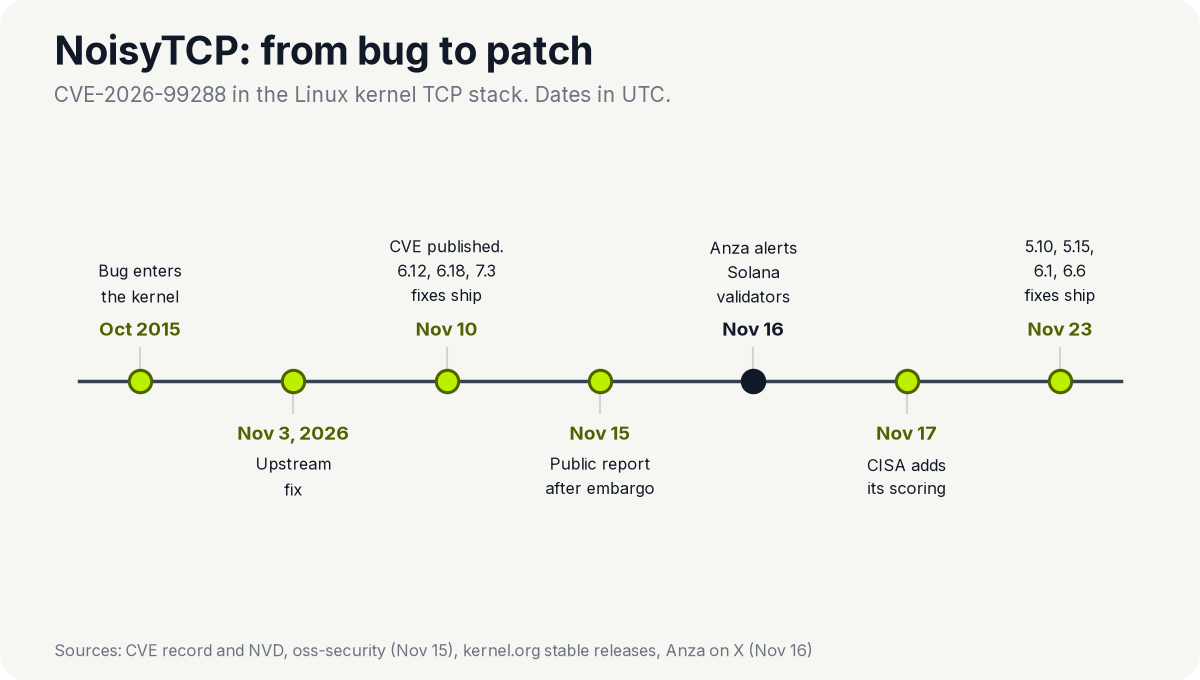
11 years. That is how long the NoisyTCP bug sat in the Linux kernel before it was fixed. It entered the kernel on October 3, 2015, and the fix landed on November 3, 2026 (oss-security report). On November 16, Anza told every Solana mainnet validator running Agave to act on it (Anza on X).
NoisyTCP, tracked as CVE-2026-99288, lets an attacker on the network crash a Linux server by sending it TCP packets. It is a bug in the Linux kernel, not in Solana software. It matters to Solana because validators run on Linux, and a crashed server cannot vote or produce blocks.
Here is what the bug is, how severe it is, what Anza told operators, and how a professional validator rolls out a kernel patch while keeping its leader slots and votes covered.
Quick answer
- What it is. A race condition in the Linux kernel's TCP code. A remote attacker with no login can trigger a kernel panic, which takes down the whole host.
- Severity. The kernel's CVE team scored it 7.5 (High). CISA scored it 5.9 (Medium) and rated the attack complexity High. Neither scoring shows an impact on confidentiality or integrity (CVE record).
- The fix. Patched stable kernels shipped on kernel.org between November 10 and November 23, 2026. Distributions ship their own builds.
- What Anza said. Applies to all Agave nodes, staked or unstaked. Patch your Linux distribution. Until the patch is in, turn off SYN cookies as a stopgap. No validator restart needed for that step (Anza).
- For delegators. You do not patch anything. Your SOL stays in your stake account. Patching is the operator's job.
What is NoisyTCP (CVE-2026-99288)?
Security researcher Hyunwoo Kim reported and patched the bug. He published the details on the oss-security mailing list on November 15, 2026 (UTC), once the embargo agreed with Linux distributions expired. He named it NoisyTCP (oss-security).
The CVE record gives the technical cause. When a TCP packet arrives, the kernel looks up which connection it belongs to. That lookup runs without locks. Memory for an old connection request can be reused for a new one before the lookup finishes. In the bad case, the lookup grabs the new request, which has no listener attached. The kernel then reads through an empty pointer and panics (CVE-2026-99288).
In plain terms:
- Who can trigger it. Anyone who can send TCP packets to the server. No account or login is needed.
- What it hits. "Plain" TCP listeners. The report names Nginx, Apache and SSH servers in their default setup.
- What happens. The kernel crashes. If the target runs in a container, the whole host goes down, not the container's app alone.
- What it needs. Packet processing spread across CPUs: servers with two or more receive queues, or with packet steering (RPS) turned on.
The report describes a second path that can lead to a use-after-free, a more serious memory bug. Kim wrote that it "is generally hard to trigger without using special techniques" (oss-security).
How severe is NoisyTCP?
Two official scores sit on the CVE record. They differ on one point: how hard the attack is.
| Scorer | CVSS 3.1 | Attack complexity | Impact |
|---|---|---|---|
| Linux kernel CVE team (CNA) | 7.5 High | Low | Availability: High. Confidentiality and integrity: None. |
| CISA (ADP) | 5.9 Medium | High | Availability: High. Confidentiality and integrity: None. |
Source: CVE record and NVD. On November 17, CISA's SSVC entry listed exploitation as "none," automatable as "yes" and technical impact as "partial."
The report shows why the scores differ. The attacker has to win a race between two CPUs. Timing decides how fast that happens:
- Virtual machines. Against Nginx, Apache and SSH in default setups on QEMU/KVM virtual machines, it took about 5 seconds to 2 minutes.
- Quiet bare metal. Against Nginx on a quiet bare-metal server with 8 receive queues, it took about 14 hours, with a proof of concept tuned to the target.
For a validator, "hard but possible" is not good enough. A crash during a leader slot means missed blocks. A crash that repeats means a validator that cannot stay online.
Which Linux kernels are affected and fixed?
The CVE record lists kernels from 4.4 onward as affected and gives a fixed version for each stable branch. Stable releases on kernel.org carry the fix from these versions:
| Kernel branch | First fixed version | Released on kernel.org (UTC) |
|---|---|---|
| 7.3 | 7.3.4 | November 10, 2026 |
| 6.18 | 6.18.63 | November 10, 2026 |
| 6.12 | 6.12.117 | November 10, 2026 |
| 6.6 | 6.6.163 | November 23, 2026 |
| 6.1 | 6.1.193 | November 23, 2026 |
| 5.15 | 5.15.226 | November 23, 2026 |
| 5.10 | 5.10.275 | November 23, 2026 |
| Mainline | 7.4-rc2 | Fix commit dated November 3, 2026 |
Sources: CVE record for versions, kernel.org release files for dates, oss-security for the fix date.
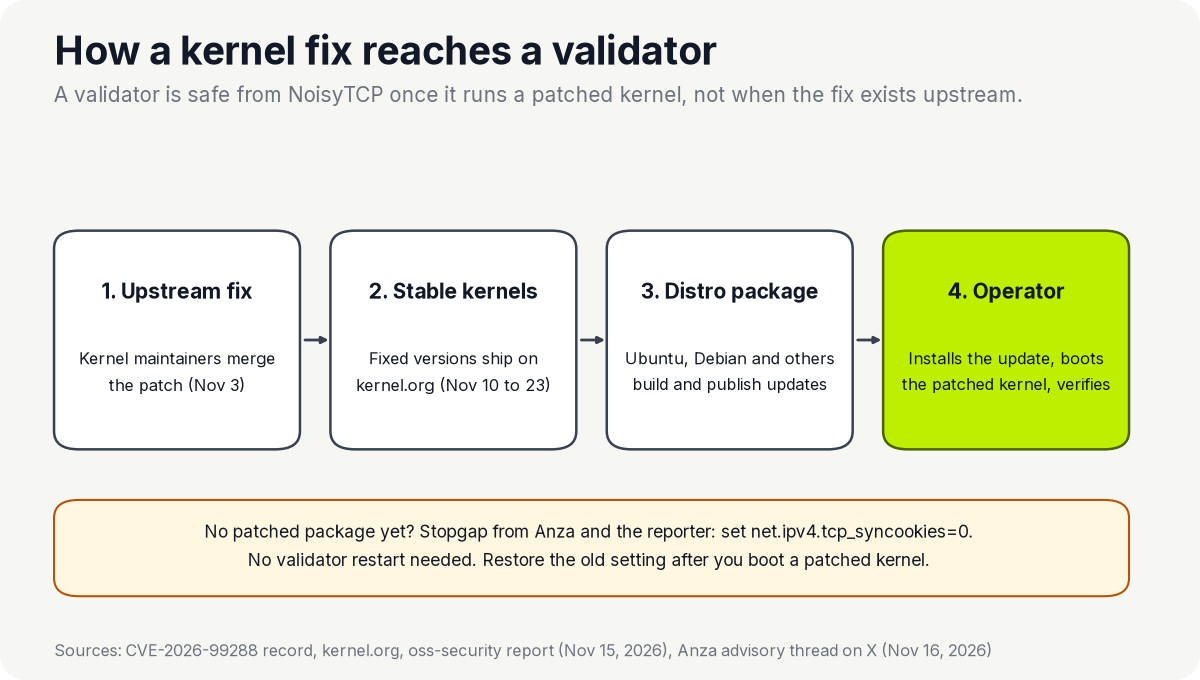
Most servers do not run a kernel straight from kernel.org. They run a build from their Linux distribution, which backports fixes into its own version numbers. That is why Anza pointed operators to their distribution's advisory, not to a version number. Debian's tracker lists fixed packages. Ubuntu's tracker, last updated November 23, lists its kernels as vulnerable, with fixes in progress, so the stopgap is the path for Ubuntu hosts until a package ships. Check your distribution's tracker, such as Ubuntu or Debian, for the package that fixes CVE-2026-99288.
What Anza told Solana validators
Anza, the team behind the Agave validator client, posted the advisory on November 16, 2026, at 15:37 UTC (9:37 a.m. CT). It opened: "Mainnet validators: Linux kernel bug CVE-2026-99288 (NoisyTCP) requires URGENT action. Instructions apply to all Agave nodes, staked or unstaked. No validator restart needed" (Anza).
The thread gave three steps:
- Patch. "Upgrade to a patched kernel as soon as your distro ships one." Check the distribution's advisory to confirm whether the running kernel is affected (step 1).
- Stopgap. "No patched kernel? Disable SYN cookies as a temporary measure. No validator restart needed" (step 2).
- Restore. "Once you've booted into a patched kernel, restore SYN cookies to their previous setting" (step 3).
The reporter gives the same stopgap: sudo sysctl -w net.ipv4.tcp_syncookies=0. Two cautions come with it. The setting is per network namespace, so it has to be applied in each container with its own network namespace. And turning off SYN cookies lowers protection against SYN floods, a different kind of attack. A second stopgap is to cut the receive queues to one and turn off RPS and RFS packet steering (oss-security).
This was Anza's second Linux kernel alert in a month. On November 1 (CT), it warned validators about a separate critical kernel flaw, CVE-2026-98432 (Anza, our coverage).
Why a Linux kernel bug matters to a Solana validator
A Solana validator earns for its stake by voting and by producing blocks in its leader slots. Agave's own docs say operators should not be offline during a leader slot, "for the health of the cluster and also for your validator's ability to earn transaction fee rewards" (Agave operations best practices).
A kernel panic stops the machine. The validator stops voting and misses any leader slots until it is back and caught up. Its delegators miss the rewards those slots and votes would have earned. That is why a server bug becomes a staking issue, and why Anza flagged it to every mainnet node.
How a professional Solana validator handles a kernel patch
A kernel patch needs a reboot. A reboot takes a validator offline. The craft is in keeping that downtime as close to zero as possible. The steps below build on the public Agave docs and the stopgap from the advisory. They apply to any operator.
1. Triage the advisory
Read the CVE and the client team's advisory. Confirm which hosts run an affected kernel. Check the distribution's tracker for a fixed package. Every node counts, staked or not, per Anza.
2. Apply the stopgap first
Where no patched package exists, set net.ipv4.tcp_syncookies=0 in each network namespace. No validator restart is needed. Record the old value so it can be restored (Anza, oss-security).
3. Stage and test the patched kernel
Install and test the patched kernel on a non-voting machine first. Installing a kernel package does not stop the validator. The reboot does. Agave's docs say the same about validator software: the node does not need to be offline while a new version is built, and the restart is what takes it offline (Agave docs).
4. Reboot outside leader slots
Check the leader schedule with solana leader-schedule and pick an idle window. agave-validator exit waits for an idle window before it stops the process (Agave docs). A host reboot plus catchup takes longer than a process restart, so a single machine misses votes while it is down. The failover in step 5 avoids that.
5. Fail over to a hot spare
The Agave failover guide runs two machines. One votes with the staked identity. The other runs with an unstaked identity. To switch, the active node waits for a restart window (agave-validator wait-for-restart-window), drops to its unstaked identity, and hands its consensus state to the spare. Under Alpenglow, that state is the vote_history file. The spare then takes the staked identity with set-identity. The primary can reboot into the patched kernel while the spare votes (Agave failover guide).
The guide has a safety rule for when the vote history file is unavailable: make sure the primary is shut down, and that the spare has caught up and finalized slots past the primary's last vote, before the spare takes over (Agave failover guide). Two machines voting with one identity is the failure to avoid.
6. Keep the ledger and verify
After a planned restart, Agave's docs advise against downloading a new snapshot. Use --no-snapshot-fetch and check progress with solana catchup. Confirm the switch with agave-validator monitor (Agave docs, failover guide). Confirm the running kernel version on each host.
7. Restore the stopgap and repeat
Once a host runs the patched kernel, put SYN cookies back to their old setting (Anza). Then move to the next host, one at a time, so a voting node is always online.
What SOL delegators should know
- You do not patch. Kernel updates are the validator operator's job.
- Your SOL stays yours. Delegating does not hand over your stake account. A validator cannot move delegated SOL.
- Uptime shows up in rewards. An operator that fails over to a spare keeps voting and producing blocks for its delegators while each host reboots.
- Ask how your operator handles advisories. How fast it patches, whether it fails over to spares, and how it reports incidents.
Stake SOL with stakefish
stakefish has run validators since 2018 and supports 10+ networks. stakefish is SOC 2 Type II certified for its non-custodial staking services. As a validator, stakefish never has the ability to move your SOL.
Our Solana fees are public: 5% on protocol rewards and 10% on MEV rewards. From 100 SOL of protocol rewards, you keep 95 SOL. Our validator address is 7VGU4ZwR1e1AFekqbqv2gvjeg47e1PwMPm4BfLt6rxNk, so you can check our record on any Solana explorer (stake.fish/solana).
- Stake SOL with stakefish
- Talk to us about institutional staking
- Read the stakefish API docs
More on Solana from us: Alpenglow explained, where Solana validator revenue comes from and why short-window APR misleads.
Our news brief: Anza tells Solana validators to patch NoisyTCP (CVE-2026-99288)
FAQ
What is NoisyTCP?
NoisyTCP is the name for CVE-2026-99288, a race condition in the Linux kernel's TCP code. A remote attacker with no login can send packets that make the kernel panic and take the server down. The CVE record was published on November 10, 2026, and the full report followed on November 15. The bug had been in the kernel since October 2015.
Is NoisyTCP a Solana bug?
No. It is a Linux kernel bug. It affects Solana validators because they run on Linux. Anza told all Agave mainnet nodes, staked or unstaked, to patch on November 16, 2026.
How do I fix CVE-2026-99288?
Install your Linux distribution's patched kernel and boot into it. Fixed stable kernels include 6.12.117, 6.18.63 and 7.3.4 (November 10, 2026) and 5.10.275, 5.15.226, 6.1.193 and 6.6.163 (November 23, 2026). Until a patch is in, set net.ipv4.tcp_syncookies=0 in each network namespace as a stopgap, then restore it.
Does disabling SYN cookies require a validator restart?
No. Anza said the SYN cookie stopgap needs no validator restart. Turning off SYN cookies lowers protection against SYN floods, so restore the old setting after you boot a patched kernel.
Do SOL delegators need to do anything about NoisyTCP?
No. Delegators do not patch kernels, and their SOL stays in their own stake accounts. Validator operators handle the patch and the reboot.
Sources
Facts checked November 23, 2026.
- Anza advisory thread on X, November 16, 2026
- Anza Linux kernel alert on X, November 1, 2026
- CVE-2026-99288 record
- NVD: CVE-2026-99288
- Linux stable fix commit
- kernel.org release files
- Ubuntu CVE tracker
- Debian security tracker
- Agave validator operations best practices
- Agave validator failover guide
- stakefish Solana staking and fees
Stake SOL with stakefish: stake.fish/solana
Want analysis like this every week? Subscribe to the stakefish newsletter.
About stakefish
Founded in 2018 by Ethereum and Bitcoin veterans, stakefish is the leading validator for Proof of Stake blockchains. With support for 10+ networks, we combine institutional‑grade infrastructure with intuitive dashboards, transparent reporting, and a spotless slashing record so individuals and institutions alike can stake confidently while strengthening decentralized networks.
Visit our website 🐠 | Telegram | X | YouTube | LinkedIn