Solana inflation schedule: what SIMD-0550 changes for SOL stakers
Solana inflation is 3.56% and falls 15% a year. SIMD-0550 makes it 30%. Status of the gate, the new curve and what it means for SOL staking yield.


3.56%. That is Solana's inflation rate today, at epoch 1082 (getInflationRate). It falls 15% a year toward a 1.5% floor. Validators voted in August to make it fall 30% a year. That change, SIMD-0550, is not active on mainnet.

Meaning: once the gate is on, Solana reaches its 1.5% floor in about 2.6 years instead of about 5.7. Issuance-funded staking yield steps down on the same path.
How Solana inflation works
Solana pays stakers with new SOL. The schedule has three settings (Anza docs):
- Initial rate: 8% a year.
- Disinflation rate (taper): the rate drops 15% each year.
- Long-term rate: 1.5% a year, the floor.
The live chain reports the same values. On Nov 10, 2026, getInflationGovernor returned initial 0.08, taper 0.15 and terminal 0.015. The foundation share is 0.
A protocol "year" is a set number of slots, not a calendar year. Since the move to 200ms slots, that number is 157.8M slots (SIMD-0525). Slots averaged 0.214 seconds over the last hour of RPC samples, so a protocol year runs about 390 days.
New SOL goes to staked accounts that vote. So the yield on staked SOL from issuance is the inflation rate divided by the share of supply that is staked. Anza docs call this the staked yield and note that it ignores uptime and commission (Anza docs).
What SGP-0002 and SIMD-0550 change
SGP-0002 was part of Solana's first network-wide governance vote. It passed on Aug 28, 2026 with 67% support, against a two-thirds bar. About 25% voted against and 7.84% abstained. Turnout was 60.7% of eligible stake (CoinDesk).
The same ballot had two other items. SGP-0001, a governance framework, passed with 95.35%. SGP-0003, a fee change that would burn more SOL, failed with about 54% (CoinDesk). So issuance falls faster, with no new burn to go with it.
SIMD-0550 is the technical change behind SGP-0002. It moves one setting, the taper, from 0.15 to 0.30. The 8% start and the 1.5% floor stay the same (Coin Brief). Two earlier tries at cutting issuance did not pass: SIMD-0228, a market-based model, and SIMD-0411, which SIMD-0550 replaced (Vortex).
Three details matter for stakers (Coin Brief):
- No jump at the switch. At activation, clients compute an anchor rate from the 15% schedule. The 30% taper runs from that anchor, so the rate does not drop on the day.
- Nothing is retroactive. The new schedule governs rewards from the epoch after activation.
- The gate is permanent. Rewards feed into bank hashes, so the client keeps the gate to replay history the same way.
The proposal authors estimate the change cuts issuance by about 18.9M SOL over six years, about 2.6% below the current schedule (Coin Brief). Our own run from today's rate and supply gives about 18.5M SOL over six protocol years.
When does it take effect?
There is no activation date. Anza, the team behind the Agave client, said SIMD-0550 ships as one feature gate that sets the taper to 0.30, and that one prerequisite must land first (Anza on X).
That prerequisite is SIMD-0607. It replaces floating-point math in reward calculation with integer math, so Agave and Firedancer compute the same rewards to the lamport. Anza targeted Agave v4.4 for it (Anza on X). SIMD-0550 must activate with SIMD-0607 or after it (Coin Brief).
Status on Nov 10, 2026:
- The public mainnet RPC endpoint reports Agave version 4.4.0 in its responses (Solana mainnet RPC).
- The SIMD-0607 gate is not active on mainnet-beta, testnet or devnet (Vortex).
- The SIMD-0550 gate is not active on any cluster (Vortex).
- The live governor reports a 0.15 taper (getInflationGovernor).
One tip for anyone who models SOL rewards. After activation, the governor will read initial 0.08 and taper 0.30. The rate decays from the activation anchor, not from genesis. So the textbook formula, 8% times 0.7 to the power of years, will give the wrong number (explainer). Read getInflationRate, which the node computes.
What it means for SOL staking yield
On Nov 10, 2026, total supply was 637.3M SOL (getSupply). Active stake across vote accounts was 435.0M SOL (getVoteAccounts). That is 68.3% of supply staked.
At 3.56% inflation, issuance alone pays 5.22% a year on staked SOL, before commission and uptime. The chart below holds the staked share at 68.3% and runs both schedules forward.
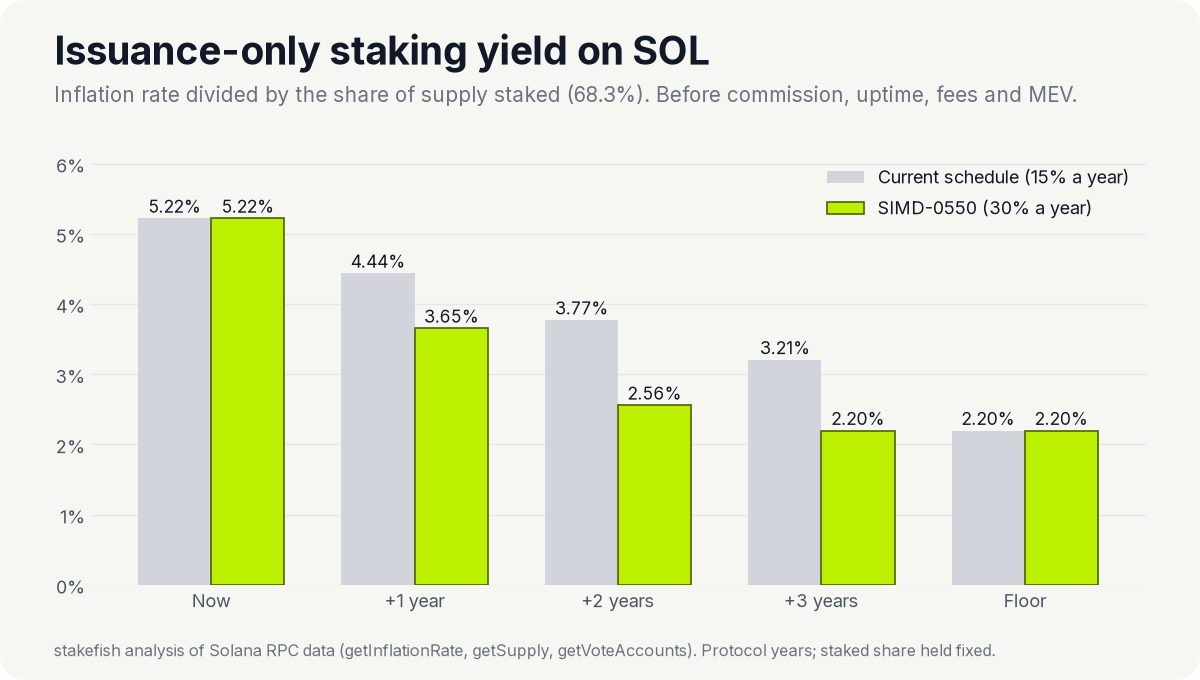
| Point in time | Inflation, 15% taper | Inflation, 30% taper | Issuance yield, 15% | Issuance yield, 30% |
|---|---|---|---|---|
| Nov 10 (epoch 1082) | 3.56% | 3.56% | 5.22% | 5.22% |
| +1 protocol year | 3.03% | 2.49% | 4.44% | 3.65% |
| +2 protocol years | 2.57% | 1.75% | 3.77% | 2.56% |
| +3 protocol years | 2.19% | 1.50% | 3.21% | 2.20% |
| Floor | 1.50% | 1.50% | 2.20% | 2.20% |
Four points to keep in mind:
1. Your share of supply is what counts. Inflation dilutes every holder. Stakers receive the new SOL, so a staked position grows its share of supply. Unstaked SOL loses share. Lower inflation shrinks both sides: smaller nominal rewards, and less dilution of the SOL you hold (Anza docs).
2. Fees and MEV carry more weight. In our sample before Alpenglow, inflation paid 88.2% of gross Solana validator revenue. Block fees and Jito tips paid 11.8% (stakefish analysis). As issuance falls, that mix shifts toward fees and tips, which swing with demand.
3. The staked share moves. We held it at 68.3%. If stake leaves as yield falls, the yield on the stake that stays rises. If stake grows, it falls further. Anza docs note the staked share is dynamic by design.
4. Short windows mislead. Per-epoch reward rates swing with leader slots and block luck. Compare validators over longer windows. Our post on validator luck covers why.
What should institutions do about SIMD-0550?
- Update reward models. Use a 30% taper from the activation epoch, anchored to the live rate. Do not rebuild the curve from genesis.
- Watch the gate. Track the SIMD-0607 and SIMD-0550 feature gates, then confirm the change in getInflationGovernor and getInflationRate after the epoch boundary.
- Report by source. Split SOL rewards into inflation, block fees and MEV. The issuance line will shrink first.
- Check your validator's setup. Ask how it captures priority fees and tips, and what share it passes to stakers.
Bottom line
Solana inflation is 3.56% and falls 15% a year today. SGP-0002 passed with 67% support to make that 30% a year through SIMD-0550. The gate is not active, and it waits on SIMD-0607. Once it is on, the 1.5% floor arrives about three years sooner, and issuance-funded staking yield falls with it. Rewards from fees and MEV matter more from here.
For institutions: the stakefish Solana staking API handles stake account creation, delegation, merging, splitting and withdrawals. Read the Solana staking API docs or request access.
Frequently asked questions
What is Solana's inflation rate in 2026?
The getInflationRate RPC method returned 3.56% at epoch 1082 on November 10, 2026. The rate falls 15% a year toward a 1.5% floor.
What is SIMD-0550?
SIMD-0550 doubles Solana's disinflation rate from 15% to 30% a year. The 8% initial rate and 1.5% floor stay the same. Validators approved it as SGP-0002 on August 28, 2026, with 67% support.
When will Solana's new inflation schedule start?
No date is set. The SIMD-0550 feature gate needs SIMD-0607, which moves reward math to integers, to activate first or at the same epoch boundary. As of November 10, 2026, neither gate is active on mainnet.
How much will SOL staking yield fall?
At 68.3% of supply staked, issuance alone pays 5.22% today. After one protocol year, that falls to about 4.44% on the current schedule or 3.65% under SIMD-0550. At the 1.5% floor it is about 2.20%. These figures exclude commission, uptime, fees and MEV, and they assume the staked share holds.
When does Solana reach 1.5% inflation?
From today's rate, in about 5.3 protocol years on the current schedule and about 2.4 under SIMD-0550 if it activated at epoch 1082. At current slot times, that is about 5.7 and 2.6 calendar years.
Sources
- Solana mainnet RPC,
getInflationRate,getInflationGovernor,getSupply,getVoteAccounts,getRecentPerformanceSamples, Nov 10, 2026 - Anza docs, Inflation Schedule
- SIMD-0525, slots per year for inflation
- CoinDesk, Solana vote to double disinflation passes
- Coin Brief, SIMD-0550 rebuilt on the integer schedule
- Anza on X, SIMD-0550 and SIMD-0607 sequencing
- Vortex, SIMD-0550 feature gate status
- Vortex, SIMD-0607 feature gate status
- Vortex, SIMD-0411 status
- stakefish, Solana tips and fees: 12% of validator revenue
Read more: Alpenglow explained for institutional stakers and The State of Solana in 2026.
Building staking into a platform? The stakefish Multi-Chain Staking API and SDK cover Ethereum, Solana and more. Read the API docs.
Stake SOL with stakefish: stake.fish/solana
About stakefish
Founded in 2018 by Ethereum and Bitcoin veterans, stakefish is the leading validator for Proof of Stake blockchains. With support for 10+ networks, we combine institutional‑grade infrastructure with intuitive dashboards, transparent reporting, and a spotless slashing record so individuals and institutions alike can stake confidently while strengthening decentralized networks.
Visit our website 🐠 | Telegram | X | YouTube | LinkedIn