Solana tips and fees: 12% of validator revenue
Inflation pays 88% of Solana validator revenue. Block fees add 8.9% and Jito tips 2.9%. How we measured it, and why per-epoch numbers mislead now.

11.8%. That is the share of Solana validator revenue that came from block fees and Jito tips in our sample, late September to Oct 20, 2026. Inflation paid the other 88.2%.
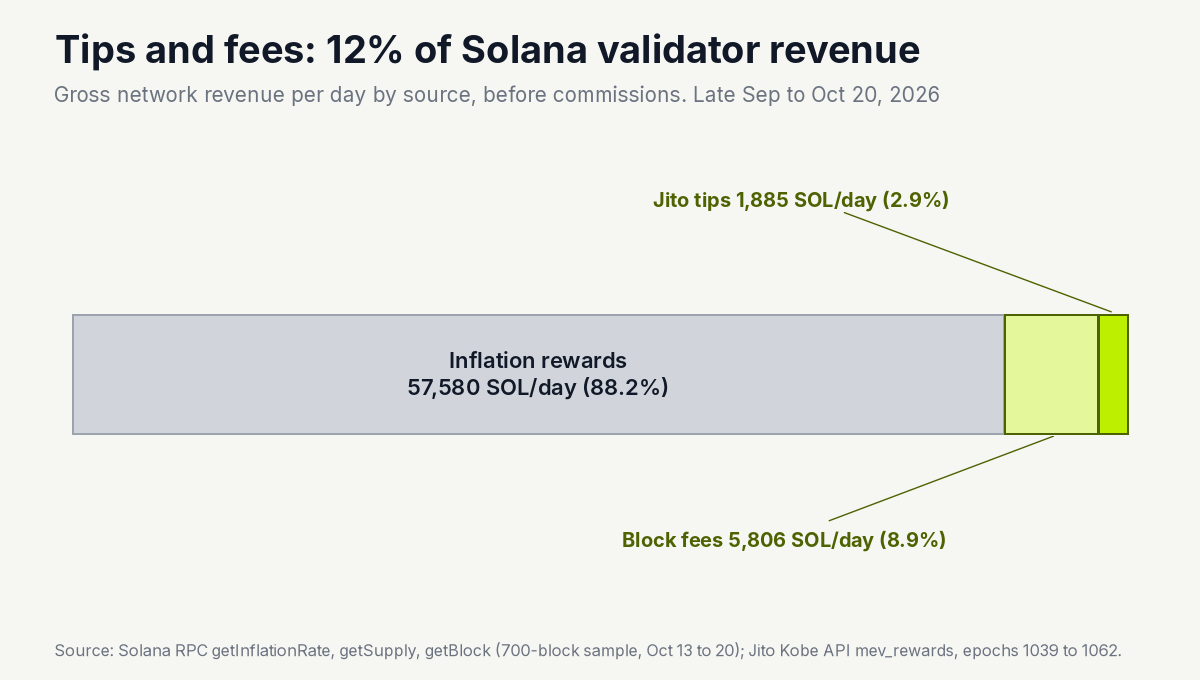
Meaning: on Solana, most staking yield is still new issuance. Fees and MEV are the smaller, more variable part.
Three sources of revenue
A Solana validator earns from three sources:
- Inflation rewards. New SOL issued each epoch to staked accounts that vote. An epoch is 432,000 slots (Agave docs).
- Block fees. When a validator is leader, it produces blocks and keeps fees from them. Each transaction pays a base fee of 5,000 lamports per signature, half of which is burned. It may add a priority fee to move up in line. The leader keeps all of the priority fee (Solana docs).
- Jito tips. Searchers and traders pay tips to land bundles, groups of transactions that execute in order, through the Jito block engine. Tips collect in a per-epoch account for each validator that runs the Jito client. After the epoch, the validator keeps its MEV commission and the rest is split pro rata among its stakers (Jito docs).
How we measured it
All figures are gross, before validator commissions, per day.
Inflation. The getInflationRate RPC method returned a total rate of 3.5937% on Oct 20, 2026. The getSupply method returned 636,151,765 SOL. The protocol pays that rate over a "year" of 157.8M slots, the setting SIMD-0525 adopted for 200ms slots. That is about 62,590 SOL per 432,000-slot epoch. Slots have averaged 0.2174 seconds, not 0.2, so an epoch runs about 26 hours. That works out to 57,580 SOL of new issuance per day.
Block fees. We sampled 700 blocks from Oct 13 to 20 with getBlock and read the fee reward paid to each leader. The mean was 0.014605 SOL per block, with 1,073 transactions per block. At the current slot time of 0.2174 seconds, that is 5,806 SOL per day.
Jito tips. The Jito Kobe API reports total tips per epoch. Over epochs 1039 to 1062 (Sep 20 to Oct 20, 2026), tips averaged 1,885 SOL per day.
| Source | SOL per day | Share |
|---|---|---|
| Inflation | 57,580 | 88.2% |
| Block fees | 5,806 | 8.9% |
| Jito tips | 1,885 | 2.9% |
| Total | 65,271 | 100% |
Spread across 438,577,211 SOL of active stake (getVoteAccounts, Oct 20), fees and tips add 0.64 percentage points of gross yield a year. That is our derived figure, before commissions.
Why per-epoch numbers mislead now
Solana epochs got shorter. Using getBlockTime at epoch boundaries, the average slot time fell from 397 ms in epoch 881 (November 2025) to 218 ms in epoch 1062. Epoch 1062 lasted 94,025 seconds, about 26 hours. Epoch 881 lasted 171,637 seconds, about 48 hours.
That changes how to read the data:
- Tips and fees per epoch fall when epochs get shorter, even if demand is flat. You need to divide by epoch length.
- Inflation per epoch fell by about half when slots went to 200ms. SIMD-0525 doubled the protocol's slots-per-year setting so yearly issuance would stay the same. Real slots run a little slower than 200ms, so issuance per calendar day now runs about 8% below the headline rate.
So we report everything per day. A dashboard that shows "tips per epoch" over the last year will show a drop, and part of that drop is a clock effect.
Tips over 12 months
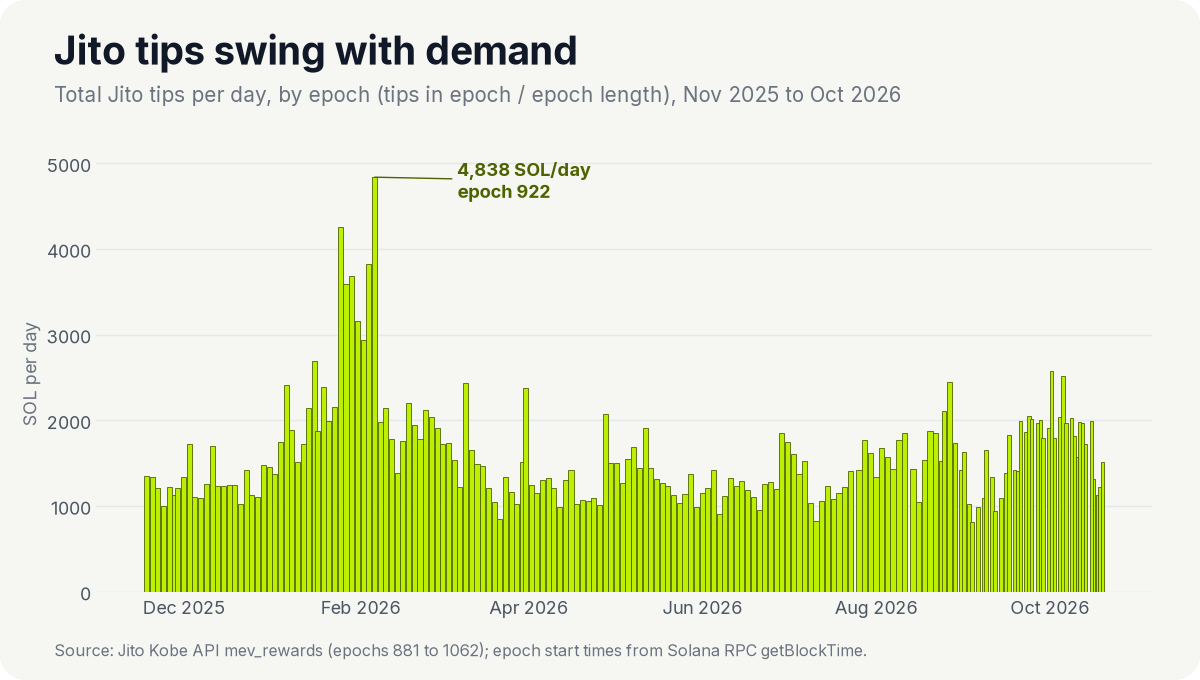
Per-day tips moved in a wide band:
| Month | Jito tips, SOL per day |
|---|---|
| Nov 2025 | 1,225 |
| Jan 2026 | 2,416 |
| Feb 2026 | 2,333 |
| Apr 2026 | 1,251 |
| Jul 2026 | 1,311 |
| Oct 2026 (to date) | 1,848 |
Per the Jito Kobe API, the peak was epoch 922, starting Feb 5, 2026, at 4,838 SOL per day. The low was epoch 1028, starting Sep 3, 2026, at 809 SOL per day. The median epoch was 1,431 SOL per day.
Meaning: tips track trading demand. A 6x swing between the busiest and quietest epoch is normal. Inflation does not move like that.
What this means for stakers
1. The base yield is inflation, and it falls on a schedule. The getInflationGovernor RPC method returns the schedule: an 8% initial rate that tapers 15% a year toward a 1.5% terminal rate. Fees and tips do not offset that today. At 11.8% of revenue, they would need to grow a lot to replace a cut in issuance.
2. Ask how your validator shares fees and tips. Inflation commission is one setting. Jito MEV commission is a second, separate setting. Block fees go to the validator's identity account. Whether stakers see any of them depends on the operator.
3. Leader slots drive fee revenue. Fees and tips reach a validator when it is leader, and at no other time. Leader slots are assigned by stake, with random variation. Over one epoch, a validator with 100,000 to 300,000 SOL can get 79% to 118% of its expected slots (10th to 90th percentile). See our post on validator luck for the details.
4. Alpenglow changes the fee mix. Our sample predates Alpenglow, which went live on Solana mainnet on October 21, 2026. Part of the block fees in our sample came from vote transactions, which validators paid to send. Under Alpenglow, votes no longer go on chain as transactions. Each voting validator pays a Validator Admission Ticket (VAT) of 0.8 SOL per epoch instead, and it is burned (Solana Foundation). Expect block fees to run lower than in our sample. We will rerun these numbers over post-Alpenglow epochs.
Bottom line
On Solana today, 88.2% of validator revenue is inflation. Block fees add 8.9% and Jito tips 2.9%. Tips swing 6x with demand. Measure per day, not per epoch, or the shorter slot time will skew the picture.
For institutions: the stakefish Solana staking API handles stake account creation, delegation, merging, splitting and withdrawals. Read the Solana staking API docs or request access.
Sources
- Solana mainnet RPC,
getInflationRate,getInflationGovernor,getSupply,getVoteAccounts,getBlock(700-block sample),getBlockTime, Oct 13 to 20, 2026 - Solana docs, Fees
- Solana docs,
getVoteAccounts - Jito docs, Tip Distribution Program
- Jito Kobe API,
mev_rewardsby epoch (881 to 1062) - Solana Foundation, Alpenglow
- stakefish Multi-Chain Staking API and SDK launch post
Building staking into a platform? The stakefish Multi-Chain Staking API and SDK cover Ethereum, Solana and more. Read the API docs.
Stake now at: stake.fish/stake
About stakefish
Founded in 2018 by Ethereum and Bitcoin veterans, stakefish is the leading validator for Proof of Stake blockchains. With support for 20+ networks, we combine institutional‑grade infrastructure with intuitive dashboards, transparent reporting, and a spotless slashing record so individuals and institutions alike can stake confidently while strengthening decentralized networks.
Visit our website 🐠 | Telegram | X | YouTube | LinkedIn