Ethereum gas limit: 30M to 60M, 200M in testing
Ethereum's gas limit sat at 30M for 3.5 years, then doubled to 60M in 10 months. Sepolia now runs 200M with Glamsterdam. What it means for stakers.

60 million. That is the Ethereum mainnet gas limit today (Etherscan). It took 3.5 years to move off 30M, then 10 months to double.
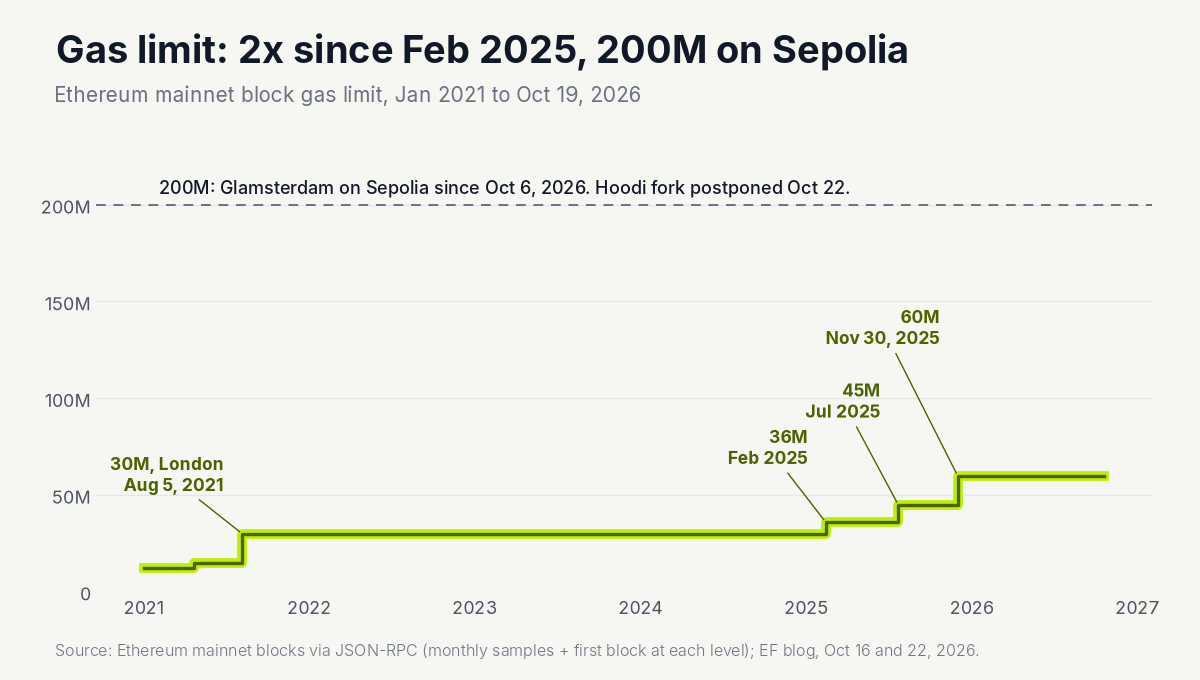
Meaning: block space on Ethereum is growing again, and the next step on testnets is more than three times today's limit.
What the gas limit is
Gas measures the work a transaction asks the network to do. The gas limit caps the total gas in one block. A higher limit means more transactions per block, and more work for every node that checks the block.
Validators set the limit, not a central party. Each block proposer can move the limit up or down by a small step from the parent block, toward the target in its client config. When most proposers set the same target, the limit walks there over a few hours or days.
Since the London upgrade, the gas limit is the hard cap and half of it is the target. When blocks use more than the target, the base fee rises. When they use less, it falls.
The history in five steps
We sampled mainnet blocks once a month from January 2021 to October 2026 and searched for the first block where the limit reached each new level. All figures come from Ethereum mainnet via JSON-RPC. Each block number links to Etherscan so you can check it.
| Date (UTC) | Block | Gas limit | What happened |
|---|---|---|---|
| Jan 1, 2021 | 11,565,019 | 12.4M | Starting point of our sample |
| Apr 22, 2021 | 12,288,957 | 14.9M | Proposers raise the limit toward 15M |
| Aug 5, 2021 | 12,965,000 | 30.0M | London upgrade. EIP-1559 doubles the cap and sets the target at half. The parent block, 12,964,999, had 15.0M |
| Feb 12, 2025 | 21,829,745 | 35.9M | Reaches 36M, the first increase since London |
| Jul 22, 2025 | 22,978,027 | 44.9M | Reaches 45M |
| Nov 30, 2025 | 23,910,666 | 59.9M | Reaches 60M, three days before Fusaka |
| Oct 19, 2026 | 26,229,305 | 60.0M | Latest in our sample |
The 60M level has a protocol anchor. EIP-7935 asked execution clients to ship 60M as the default in their Fusaka releases. Fusaka activated on Dec 3, 2025 at 21:49:11 UTC (EF blog). Our data shows proposers reached 60M three days before the fork.
Fusaka paired the higher limit with a cap on single transactions: 16,777,216 gas, per EIP-7825. No single transaction can fill a block.
How full are blocks at 60M?
We sampled 250 random mainnet blocks from the last seven days, ending at block 26,235,910. Mean gas used was 50.7% of the limit. The median was 47.5%.
That sits close to the EIP-1559 target of 50%. Demand fills the new space.
Glamsterdam: 200M on Sepolia
Glamsterdam is Ethereum's next upgrade. It combines Amsterdam (execution layer) and Gloas (consensus layer). Its two headline changes are enshrined proposer-builder separation (ePBS, EIP-7732) and block-level access lists (BALs, EIP-7928).
The rollout so far, per the Ethereum Foundation:
- Sepolia: activated Oct 6, 2026 at 13:53:36 UTC (EF blog, Sep 17).
- Hoodi: the fork set for Oct 26, 2026 was postponed on Oct 22 while developers study how EIP-8037 interacts with existing contracts. No new date is set, and Hoodi's move to 200M is on hold (EF blog, Oct 22).
- Mainnet: date not decided. Ethereum.org still lists Q4 2026, a target set before the Hoodi postponement (ethereum.org).
Ethereum.org describes 200M as a gas limit floor that Glamsterdam enables, with developers testing at a 150M reference limit to price state. That is a path, not a mainnet setting on fork day.
We sampled 200 Sepolia blocks from the last seven days, ending at block 11,957,405. Gas limits ranged from 198.8M to 200M. Mean gas used was 37.7% of the limit. Test networks carry less demand than mainnet, so this says the chain handles the limit, not that users will fill it.
Why these two changes make room for more gas
BALs list every account and storage slot a block touches, with the state changes. Clients can read state from disk in parallel and check transactions in parallel. Ethereum.org frames this as moving away from serial execution constraints.
ePBS moves the builder-proposer handoff into the protocol. A proposer commits to a builder's payload, and the builder reveals it later. The protocol then handles payment to the proposer, which the EF says reduces reliance on trusted middleware. Ethereum.org says ePBS expands the propagation window, the time the network has to spread and check block data, from about 2 seconds to about 9 seconds.
Glamsterdam reprices state, too. EIP-8037 raises and separates the cost of creating new state. EIP-8038 updates state-access costs. Without that, a bigger limit means faster state growth on every node.
What it means for stakers
- Hardware. More gas per block means more execution work and more state growth. Operators need headroom in CPU, disk and bandwidth before each limit step, not after.
- Client updates. Both execution and consensus clients must update for Glamsterdam. A node on an old client falls off the chain at the fork.
- New duties under ePBS. A payload timeliness committee will attest to whether builders revealed payloads on time. Operators and staking pools need to review the new duties and interfaces, per the EF.
- Execution rewards. More block space can mean more priority fees per block. It does not have to. Fees depend on demand, and a bigger supply of gas can lower the price per unit. We make no forecast here.
- Exits. Glamsterdam includes EIP-8061. At current staking levels, ethereum.org estimates it raises exit capacity 4x and consolidation capacity 2x. That shortens exit queues in busy periods. See our post on 12 months of ETH queue data.
Bottom line
The gas limit sat at 30M from August 2021 to February 2025. Then it doubled in 10 months. Sepolia, the first public Glamsterdam testnet, now runs 200M. For stakers, each step is an operations change first: hardware, clients and new duties.
stakefish runs Ethereum validators for retail and institutional stakers. To stake ETH with us, start at stake.fish.
Sources
- Ethereum mainnet JSON-RPC (
eth_getBlockByNumber,eth_blockNumber), monthly samples Jan 2021 to Oct 2026, first-block searches, and 7-day utilization sample, fetched Oct 19 to 20, 2026 - Sepolia JSON-RPC (ethereum-sepolia-rpc.publicnode.com), 200-block sample, last 7 days to block 11,957,405, Oct 20, 2026
- EIP-7935, Set default gas limit to 60M
- Ethereum Foundation, Fusaka Mainnet Announcement (Nov 6, 2025)
- Ethereum Foundation, Glamsterdam Testnet Announcement (Sep 17, 2026)
- Ethereum Foundation, Glamsterdam Hoodi Testnet Announcement (Oct 16, 2026) and Glamsterdam on Hoodi Postponed (Oct 22, 2026)
- ethereum.org, Glamsterdam roadmap page (last update Sep 14, 2026)
- EIP-7732 (ePBS) and EIP-7928 (BALs)
Building staking into a platform? The stakefish Multi-Chain Staking API and SDK cover Ethereum, Solana and more. Read the API docs.
Stake now at: stake.fish/stake
About stakefish
Founded in 2018 by Ethereum and Bitcoin veterans, stakefish is the leading validator for Proof of Stake blockchains. With support for 20+ networks, we combine institutional‑grade infrastructure with intuitive dashboards, transparent reporting, and a spotless slashing record so individuals and institutions alike can stake confidently while strengthening decentralized networks.
Visit our website 🐠 | Telegram | X | YouTube | LinkedIn