Ethereum's post-quantum roadmap: Mission 2028, the 2029 target and validator keys
Justin Drake hopes Ethereum finishes its post-quantum transition by December 2028. The EF target is December 2029. What each plan says, and what changes for validators.


December 2028. That is when Ethereum Foundation researcher Justin Drake hopes Ethereum finishes its post-quantum transition. He said it at Devcon 8 in Mumbai on November 3, 2026 (talk recording). The EF Protocol cluster's published target is December 2029, and it stands until a review in January 2027 (EF blog).

Meaning: the post-quantum work has moved from research into fork planning. For validators, it brings new signing keys, a new signature scheme and a fast run of client upgrades. This post covers what each plan says and what it asks of stakers.
Why Ethereum needs post-quantum cryptography
A large enough quantum computer could break the math behind most of Ethereum's cryptography. ethereum.org lists four exposed areas:
- Account signatures (ECDSA). Every standard account signs transactions this way.
- Validator signatures (BLS). Validators use BLS to vote, and the protocol combines many votes into one.
- KZG commitments. These back the data that rollups post to Ethereum.
- Some zero-knowledge proof systems. Pairing-based SNARKs share the same weakness.
Q-day is the name for the day a quantum computer can break this cryptography. Nobody knows when it comes. The EF Protocol cluster says Ethereum L1 should plan for Q-day as early as 2030 and calls that assumption aggressive by design (EF blog).
The official target: December 2029
On September 7, 2026, the EF Protocol cluster set its north star: a quantum-resistant L1 across execution, consensus and data by December 2029. It said the date lines up with 2029 migration targets set by Google, Cloudflare and Microsoft. It will treat the deadline as non-negotiable at least until January 2027, when it will reassess quantum progress with outside experts (EF blog).
The plan runs through a sequence of forks after Glamsterdam:
- Hegotá: the next fork. Its headliners are fork-choice enforced inclusion lists (EIP-7805) and frame transactions (EIP-8141). The EF calls Hegotá "the fork that decides whether the PQ forks happen on time."
- I*: holds the post-quantum public-key registry.
- J*: a minimum viable post-quantum L1. It adds a post-quantum heartbeat on the consensus layer, leanDA sampling on the data layer and leanSPHINCS transactions on the execution layer. The EF describes it as a temporary safeguard with reduced guarantees.
- L*: full post-quantum readiness under the July Strawmap, five forks after Glamsterdam. The EF is reviewing a swap that would pull post-quantum attestations forward to K*.
The math is tight. Shipping Glamsterdam in December 2026 and L* in December 2029 would need a fork every 7.2 months on average, per the EF. Fork names after Hegotá are placeholders, and ethereum.org notes that names and ordering may change.
What is Mission 2028?
At Devcon 8, Drake announced what he called "a material update to the straw map." He wants all three layers covered by J*: post-quantum transactions on the execution layer, post-quantum attestations on the consensus layer and post-quantum sampling on the data layer. In July, the Strawmap placed full post-quantum readiness in L*. The August 19 update moved a minimum viable version to J* (EF blog).
He then set a date. Drake said the team hopes to launch Glamsterdam on mainnet in January 2027. He said the hope is to wrap up the full post-quantum and post-AI transition by December 2028, which leaves 24 months to ship the three forks after Glamsterdam (Devcon 8 talk).
Three points frame the claim:
- It is a hope, not a new official target. The Foundation's December 2029 date stands until the January 2027 review (Cointelegraph, EF blog).
- The threat model is wider than quantum. Drake argued that AI may find new mathematics that weakens today's cryptographic assumptions. He said he has 2032 in mind for Q-day, with wide error bars, and gives it a 10% chance by 2029.
- Components first, forks second. His co-presenter Kev said the goal is to have all the pieces stable by the end of 2027 at the latest, then pipeline them into forks through December 2028.
What replaces Ethereum's cryptography?
The roadmap leans on hash functions. Hashes are part of Ethereum's security today, and quantum computers weaken them but do not break them (ethereum.org). At Devcon 8, Kev named SHA-3 as the current default hash.
| Layer | Today | Post-quantum replacement | What it means |
|---|---|---|---|
| Execution | ECDSA account signatures | leanSPHINCS, via frame transactions (EIP-8141) | Accounts can switch signature schemes without a fork per scheme |
| Consensus | BLS validator signatures | leanXMSS hash-based signatures | Validators sign with new keys |
| Data | KZG commitments | leanDA | Hash-based data availability sampling |
| Aggregation | BLS aggregation | leanVM, a minimal zkVM | Compresses large hash-based signatures into small proofs |
Sources: ethereum.org, EF blog and the Devcon 8 talk.
Size is the hard part. ethereum.org gives about 3,000 bytes for a leanXMSS signature and 96 bytes for a BLS signature. It says leanVM compresses that data by 250 times, so many signatures can combine into one small proof (ethereum.org). Drake said leanVM had reached end-to-end formal verification in the days before the talk.
ethereum.org says Ethereum's work builds on the post-quantum standards NIST finalized in August 2024: ML-KEM, ML-DSA and SLH-DSA (ethereum.org).
What post-quantum Ethereum means for validators
Consensus cryptography changes through hard forks, not through account-level upgrades. The EF plans to battle-test it before rollout and to ship the consensus pieces as one complete design (EF blog). Operators should prepare for four changes.
- New validator keys. ethereum.org describes an I* milestone where validators register post-quantum public keys alongside their BLS keys. At Devcon 8, Kev urged validators to engage with this registry, the first consensus-layer step.
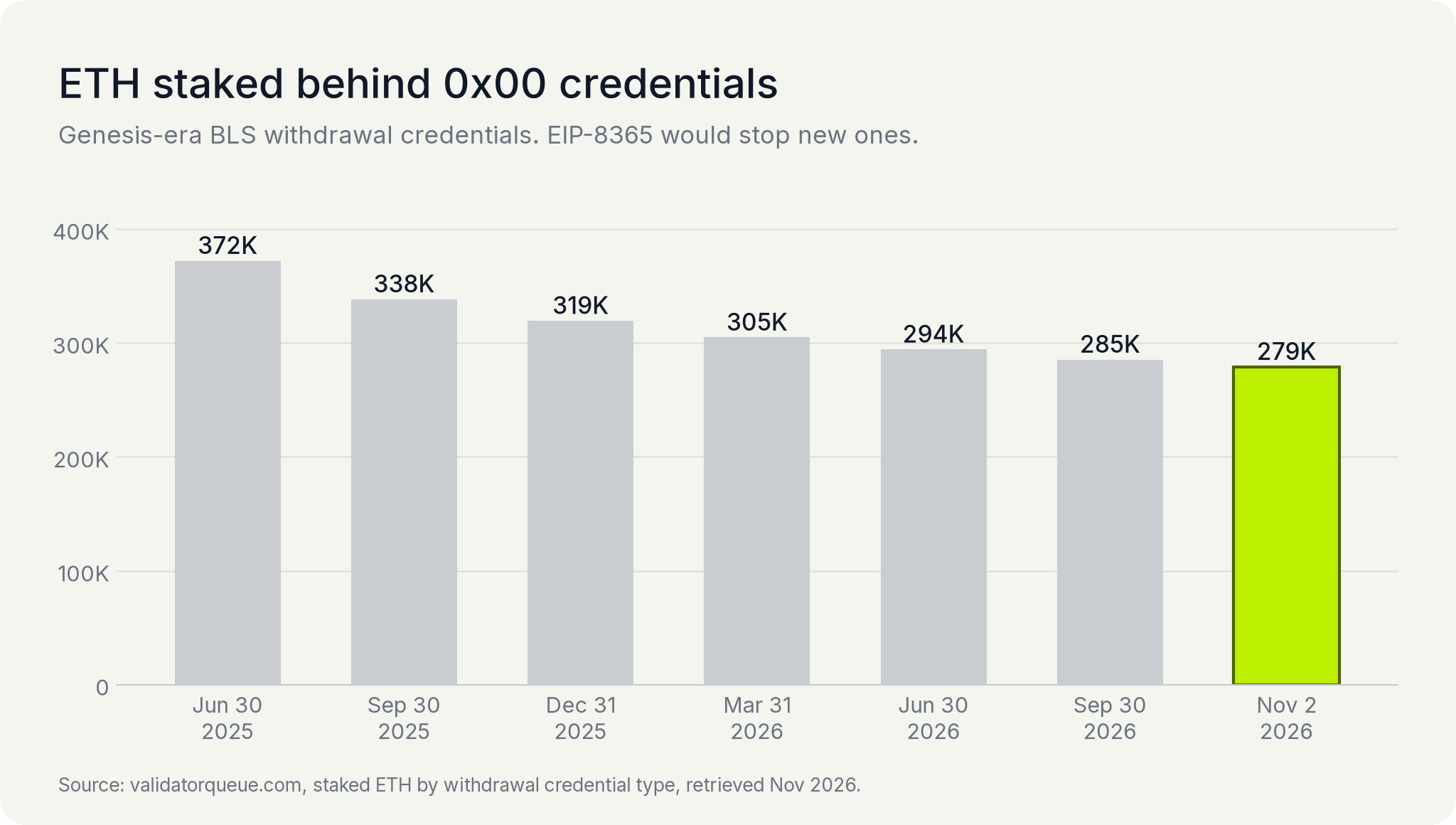
- 0x00 credentials on the way out. EIP-8365 would reject deposits that create new validators with 0x00 withdrawal credentials. Existing 0x00 validators keep validating and earning, and can convert to 0x01 credentials. On September 7, the EF Protocol team graded an earlier, larger version A and called it "the one PQ item that belongs in Hegotá" (EF tier list). On September 30, the EIP was narrowed to the rule that blocks new 0x00 deposits (EIP history). On October 1, core developers moved that version to Considered for Inclusion for Hegotá (ACDC #188).
- Bigger messages and new software. leanXMSS signatures and leanVM proofs change what validator clients sign, send and check.
- A fast fork cadence. Three forks in 24 months under Mission 2028, or a fork every 7.2 to 12 months under the EF plan, means more client releases to test and roll out.
The 0x00 group is small, and EIP-8365 says its decline has stalled. Per EIP-8365, it fell from about 600,000 validators to about 9,200 by August 2026. On validatorqueue.com, ETH behind 0x00 credentials fell from 372,146 ETH on June 30, 2025 to 279,111 ETH on November 2, 2026. It stood at 280,282 ETH on November 9.
stakefish has run Ethereum validators since Beacon Chain genesis. We will follow the registry design and the Hegotá scope as they firm up. Stake ETH with us at stake.fish.
What Ethereum holders need to do
Nothing, for the moment. ethereum.org says no quantum computer today can break Ethereum's cryptography. When post-quantum signatures are live, wallet software will guide users through the move.
Frame transactions are the path. They let an account move away from its ECDSA key and adopt new signature schemes without a fork for each one (EIP-8141). At Devcon 8, Kev said 72% of ETH supply is linked to accounts that have signed a transaction, which reveals the public key. Project Eleven's Ethereum Risq List, launched October 30, 2026, gives a similar figure: 88.1 million ETH, or 72.11% of circulating supply, tied to exposed public keys across accounts, staking and smart contracts (Project Eleven). Accounts that have never signed expose a hash of the key, not the key itself, which adds a layer of protection (ethereum.org).
What to watch
- Glamsterdam's mainnet date. Mission 2028 counts its 24 months from a Glamsterdam launch in January 2027.
- Hegotá scope. Whether EIP-8365 makes the final fork.
- The I* registry design. It sets how validators create and register post-quantum keys.
- The January 2027 review. The EF will reassess its December 2029 target with outside experts.
Frequently asked questions
When will Ethereum be quantum resistant?
The Ethereum Foundation's Protocol cluster targets a quantum-resistant L1 across execution, consensus and data by December 2029. At Devcon 8 on November 3, 2026, researcher Justin Drake said he hopes to finish by December 2028. The 2029 date is the official target until a review in January 2027.
What is Mission 2028?
Mission 2028 is the name Justin Drake gave at Devcon 8 to his hope that Ethereum completes its post-quantum and post-AI transition by December 2028. It assumes Glamsterdam reaches mainnet in January 2027 and three more forks ship in the following 24 months.
Do Ethereum validators need new keys for post-quantum?
Yes, over time. The roadmap replaces BLS validator signatures with leanXMSS, a hash-based scheme. A post-quantum public-key registry, planned for the I* fork, would let validators register post-quantum keys alongside BLS keys. No registry is live as of November 2026.
What happens to validators with 0x00 withdrawal credentials?
Draft EIP-8365 would stop deposits that create new validators with 0x00 credentials. Existing 0x00 validators keep validating and can convert to 0x01 credentials. On September 7, 2026, the EF Protocol team graded an earlier version of the EIP A for Hegotá. On October 1, 2026, core developers moved the current version to Considered for Inclusion.
Is my ETH at risk from quantum computers today?
No. ethereum.org says no quantum computer today can break Ethereum's cryptography, and that wallet software will guide users through a future migration.
Sources
- Justin Drake and Kev, Post-Quantum Transition, Devcon 8, November 3, 2026 (recording and transcript) and Devcon archive entry
- Ethereum Foundation, EF Protocol: Current and Emerging Priorities, September 7, 2026
- Ethereum Foundation, EF Protocol: The Hegotá EIP Opinion Post and Tier List, September 7, 2026
- ethereum.org, Post-quantum cryptography on Ethereum (updated October 23, 2026)
- EIP-8365: Disallow new 0x00 validators (draft)
- EIP-8141: Frame Transaction (draft) and EIP-7805: FOCIL (draft)
- Cointelegraph, Ethereum dev targets 2028 for quantum resistance, November 4, 2026
- NIST, post-quantum cryptography FIPS approved, August 2024
- Project Eleven, Ethereum Risq List launch, October 30, 2026
- All Core Devs Consensus #188, October 1, 2026 and EIP-8365 change history
- validatorqueue.com, staked ETH by withdrawal credential type, history through November 9, 2026
Building staking into a platform? The stakefish Multi-Chain Staking API and SDK cover Ethereum, Solana and more. Read the API docs.
Stake ETH with stakefish: stake.fish/ethereum
About stakefish
Founded in 2018 by Ethereum and Bitcoin veterans, stakefish is the leading validator for Proof of Stake blockchains. With support for 10+ networks, we combine institutional‑grade infrastructure with intuitive dashboards, transparent reporting, and a spotless slashing record so individuals and institutions alike can stake confidently while strengthening decentralized networks.
Visit our website 🐠 | Telegram | X | YouTube | LinkedIn