Ethereum validator consolidation: 3% of keys hold 42% of stake
0x02 validators are 2.9% of Ethereum's active set but hold 41.5% of stake. Beacon chain data on consolidation since Pectra, and what it means for stakers.

Pectra went live on Ethereum mainnet on May 7, 2025 (Ethereum Foundation). It raised the max effective balance of a validator from 32 ETH to 2,048 ETH (EIP-7251). A validator with 0x02 (compounding) withdrawal credentials earns on any balance in that range. Operators can merge many 32 ETH validators into one.
Seventeen months later, that change is reshaping the validator set. On October 22, 2026, we pulled the full validator registry from the beacon chain, and every request sent to the EIP-7251 consolidation contract since Pectra.
Here's what the data shows, who is driving it, how long a consolidation takes today, and what to check before you consolidate.
The numbers
Snapshot of the finalized beacon state on October 22, 2026, around 7:00 a.m. CT (Beacon API, stakefish analysis):
- 823,366 active validators.
- 24,044 of them (2.9%) use 0x02 credentials. They hold 18.18M ETH of effective balance, 41.5% of the 43.76M ETH total.
- 1,308 validators sit at the 2,048 ETH max effective balance. Another 7,502 hold between 1,025 and 2,047 ETH.
- The average active validator holds 53.1 ETH of effective balance.
- 202,435 consolidation requests have reached the EIP-7251 contract since Pectra. 44,537 of them arrived between October 1 and 22, 2026.
The validator count is falling
On August 1, 2025, Ethereum had 1,089,699 active validators. On October 22, 2026, it had 823,366. That is 24% fewer.
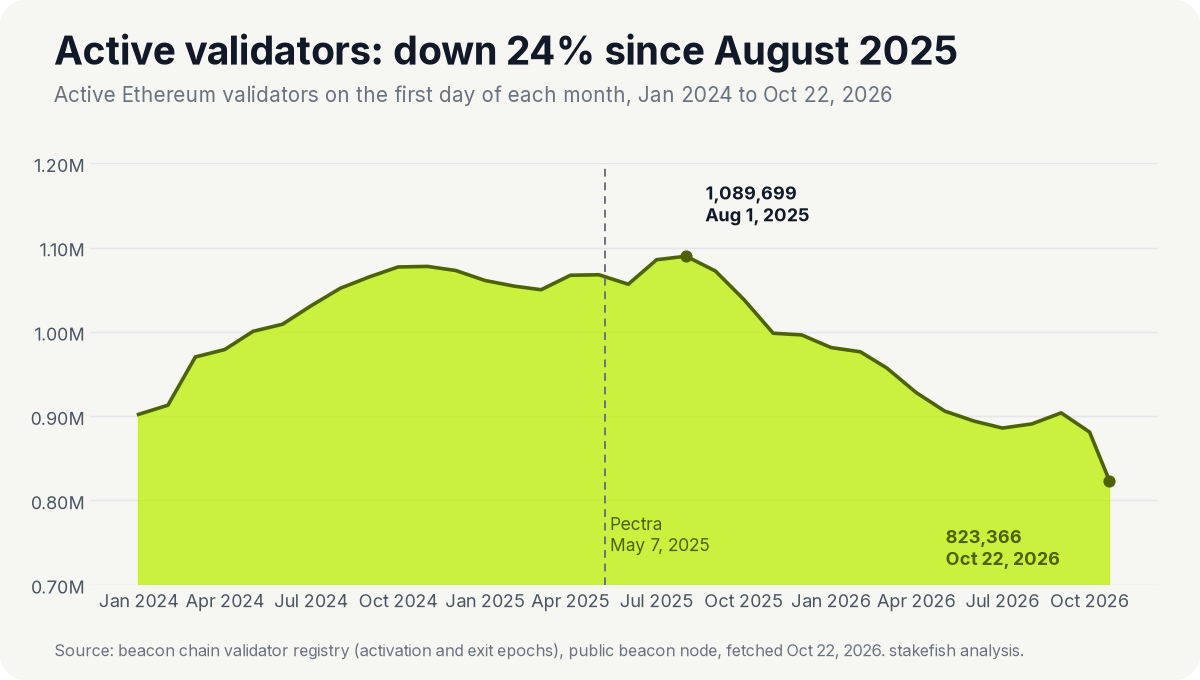
Fewer validators does not mean less stake. Before Pectra, no validator could have an effective balance above 32 ETH. Today the average is 53.1 ETH.
Not every validator that left the set merged into another. Regular exits count in this chart too. But each merge exits its source validator and moves the balance to the target, so merges push the count down without removing ETH from staking (Electra spec).
0x02 validators hold 41.5% of stake
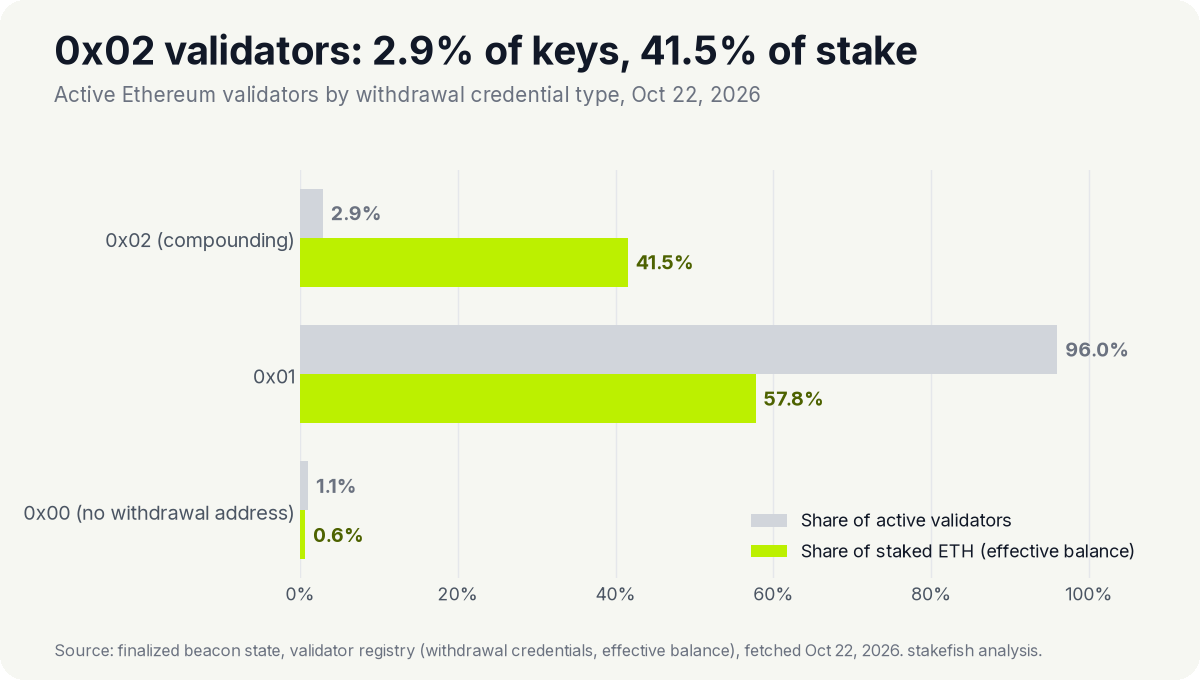
- 0x02 (compounding): 24,044 validators, 2.9% of the set, 41.5% of effective balance. 15,846 of them hold more than 32 ETH.
- 0x01: 790,476 validators, 96.0% of the set, 57.8% of effective balance.
- 0x00: 8,846 validators with 282,817 ETH. They have no withdrawal address yet. A validator needs an execution withdrawal address (0x01 or 0x02) before it can be a consolidation source (Electra spec).
For context, Lido put the network’s 0x02 share at 32.06% in July 2026 (Lido).
Who is consolidating
A consolidation request comes in two forms (ethereum.org):
- Conversion. Source and target are the same validator. It switches from 0x01 to 0x02 in place and keeps its index.
- Merge. The source validator exits and its balance moves to a 0x02 target.
Of the 202,435 requests since Pectra, 9,754 were conversions and 192,681 were merges. Requests are not completed consolidations. The beacon chain ignores a request that fails its checks, for example a target without 0x02 credentials (Electra spec).
Requests come in waves:
| Period | Requests |
|---|---|
| May 7 to 31, 2025 (Pectra launch) | 16,876 |
| June 2025 to February 2026 | 1,502 to 3,999 per month |
| March 2026 | 44,798 |
| April 2026 | 19,073 |
| May to August 2026 | 602 to 7,369 per month |
| September 2026 | 38,735 |
| October 1 to 22, 2026 | 44,537 |
Source: event logs of the EIP-7251 consolidation contract through block 26,248,042, stakefish analysis.
The September and October wave has a clear source. 80,448 requests, 39.7% of all requests since Pectra, came from Lido’s withdrawal vault (address listed in Lido’s deployed contracts).
Lido’s Curated Module v2, announced on July 27, 2026, plans to move more than 265,000 Curated Module validators from 0x01 to 0x02 through consolidations. Lido estimates this takes the network’s 0x02 share from 32.06% to 52.21%, cuts the validator count from about 880,000 to about 628,000, and lowers attestation messages by about 29% each epoch (Lido). The first Lido Core consolidation landed in September. By the end of that month, 917,438 ETH had moved, 10.4% of Curated Module stake (Lido Operator Portal).
How long a consolidation takes
A merge passes through two queues.
1. The execution layer contract. The source validator’s withdrawal address sends the request to the contract and pays a fee. The fee rises when demand is above target. The contract targets one request per block and passes at most two per block to the beacon chain (EIP-7251).
2. The consensus layer churn. The beacon chain schedules each source exit against a consolidation churn limit. That limit is the balance churn (total active balance divided by 65,536) minus the 256 ETH per epoch reserved for activations and exits (Electra spec). At 43.76M ETH of active balance, that is 411 ETH per epoch, or about 92,475 ETH per day.
On October 22, 2026, 5,924 consolidations holding 620,697 ETH were pending. The last scheduled source exit was on October 27 at 9:05 p.m. CT. A merge requested today waits about 5.6 days for its exit slot (Beacon API, stakefish analysis).
After the exit, the balance waits 256 epochs, about 27.3 hours, before it moves to the target. During that window the balance is not active (ethereum.org). A conversion does not use the churn queue. The beacon chain applies it when it processes the request (Electra spec).
Glamsterdam would change this. EIP-8061 gives consolidations their own capacity. At current staking levels, ethereum.org estimates consolidation capacity rises about 2x. Glamsterdam has no mainnet date. Its Hoodi testnet fork, set for October 26, was postponed on October 22 (Ethereum Foundation). For the full upgrade, read Glamsterdam explained.
What changes for your stake
All points below come from ethereum.org’s MaxEB guide unless noted.
- Rewards compound in 1 ETH steps. Because of a buffer called hysteresis, a 0x02 validator reaches a 33 ETH effective balance at 33.25 ETH, then 34 ETH at 34.25 ETH.
- No automatic sweeps below 2,048 ETH. A 0x01 validator gets a gasless sweep of everything above 32 ETH. A 0x02 validator needs a manual partial withdrawal, which costs gas. If your treasury books staking rewards as cash, plan for this.
- Conversion is permanent. A 0x02 validator cannot go back to 0x01.
- Proposal odds do not change. Two 32 ETH validators and one 64 ETH validator have the same total chance to propose.
- The initial slashing penalty is lower. It fell from 1 ETH per 32 ETH to 0.0078125 ETH per 32 ETH, which is 1/4,096 of effective balance (Electra spec). ethereum.org notes that for professional operators, fewer validators may mean less room to react to a slashing and stop a cascade.
- Check what you sign. The withdrawal address signs the request. A wrong or malicious target can receive the full balance of the source, with no way back.
Questions to ask your operator
- Do you support 0x02 conversions and merges for my validators? With which tool?
- Who signs the request, and how do you check the source and target keys?
- How will my reports show balances above 32 ETH and manual partial withdrawals?
- How do you schedule merges around the consolidation queue and the 27-hour wait?
- How does your slashing protection change with fewer, larger validators?
- What changes in your plan once EIP-8061 reaches mainnet?
Consolidate with stakefish
The stakefish dashboard supports all three paths: convert a 0x01 validator to 0x02, merge a 0x01 into a 0x02, and merge two 0x02 validators. Our Pectra staking guide walks through each step.
For platforms, our Ethereum API supports 0x01 and 0x02 withdrawal credentials, batch validator creation of up to 100 at once, and the full deposit flow (API and SDK launch).
- Stake ETH with stakefish
- Talk to us about institutional staking
- Read the stakefish API docs
Methodology
- Validator snapshot. Full validator registry from the finalized beacon state (slot 15,487,136), fetched from a public beacon node on October 22, 2026 at about 7:04 a.m. CT. Active means active_ongoing or active_exiting. Stake figures use effective balance.
- Monthly validator count. A validator counts as active at an epoch if its activation epoch is at or before that epoch and its exit epoch is after it. The registry keeps every validator ever created, so past counts can be rebuilt from today’s state.
- Consolidation requests. All logs of the EIP-7251 contract from the Pectra block to block 26,248,042 (October 22, 2026, 7:05 a.m. CT), read through a public Ethereum RPC. A request with the same source and target key counts as a conversion.
- Pending queue. Pending consolidations from the head beacon state at slot 15,487,296, with exit epochs of each source validator.
Sources
Facts checked October 22, 2026.
- EIP-7251: Increase the MAX_EFFECTIVE_BALANCE
- Ethereum consensus specs: Electra beacon chain
- ethereum.org: Pectra MaxEB
- Ethereum Foundation: Pectra mainnet announcement
- ethereum.org: Glamsterdam and Ethereum Foundation: Glamsterdam on Hoodi postponed
- EIP-8061: Increase exit and consolidation churn
- Ethereum Beacon APIs
- Etherscan: EIP-7251 consolidation request contract
- Etherscan: Lido withdrawal vault
- Lido docs: deployed contracts
- Lido: A new Lido Core upgrade for protocol sustainability and a leaner Ethereum
- Lido Operator Portal: September validator set updates
- stakefish: Pectra staking guide
- stakefish: Multi-Chain Staking API and SDK
Building staking into a platform? The stakefish Multi-Chain Staking API and SDK cover Ethereum, Solana and more. Read the API docs.
Stake now at: stake.fish/stake
About stakefish
Founded in 2018 by Ethereum and Bitcoin veterans, stakefish is the leading validator for Proof of Stake blockchains. With support for 20+ networks, we combine institutional‑grade infrastructure with intuitive dashboards, transparent reporting, and a spotless slashing record so individuals and institutions alike can stake confidently while strengthening decentralized networks.
Visit our website 🐠 | Telegram | X | YouTube | LinkedIn