Everything Starknet: A Complete Ecosystem Overview

Starknet has evolved from a ZK-rollup scaling solution into one of the most active ecosystems in crypto, with a growing DeFi layer, dual-token staking, a thriving BTCFi economy, and a clear path toward full decentralization. Whether you are evaluating Starknet as a staking opportunity, exploring its DeFi protocols, or considering building on the network, this guide provides a comprehensive overview of where the ecosystem stands today and where it is headed.
This is the third post in our Starknet content series. If you are new to Starknet staking, start with our guides on how to stake STRK and how to stake BTC on Starknet with stakefish.
What Is Starknet?
Starknet is a Validity Rollup (ZK-Rollup) Layer 2 network that operates on top of Ethereum. It uses STARK proofs, a type of zero-knowledge proof that is post-quantum secure and requires no trusted setup, to bundle thousands of transactions offchain and verify them on Ethereum in a single proof. The result is high throughput, low fees (often sub-cent), and Ethereum-level security.
Unlike most other L2s, Starknet does not use the Ethereum Virtual Machine (EVM). It runs on the Cairo Virtual Machine and the Cairo programming language, which is purpose-built for provable computation. This architectural choice gives Starknet a performance ceiling that EVM-based rollups cannot reach, enabling complex onchain applications like fully onchain games, AI inference, and advanced DeFi strategies.
Key technical differentiators include native account abstraction (every account is a programmable smart contract), a decentralized sequencer architecture powered by Tendermint consensus with 2-second blocks during low congestion, and Stage 1 rollup status confirmed by L2Beat, making it the only ZK-rollup to achieve this designation.
Staking on Starknet: Dual-Token Consensus
Starknet is the first rollup to implement a dual-token staking model. Validators are secured by both STRK and BTC, with STRK providing 75% of total staking power and BTC providing 25%. This design allows Bitcoin holders to contribute to network security and earn STRK rewards without selling their BTC, while STRK holders earn yield at competitive rates.
Current Staking Stats
Source: Endur Staking Dashboard. Staking is currently in Phase 2 (block attestation), with Phase 3 (block validation) expected in 2026 and Phase 4 (full decentralization) to follow. Validators are required to run full nodes and attest to blocks using tools like Juno (Nethermind) or Pathfinder (Equilibrium). The Starknet Foundation matches validator stake 1:1 up to 5M STRK for qualifying validators.
How BTC Staking Rewards Work
BTC staking rewards are paid in STRK and calculated using a dynamic formula. BTC stakers receive a fixed 25% share of total STRK emissions, meaning the APR depends on three variables: the total amount of BTC staked (more BTC = lower per-unit APR), the STRK minting rate, and the STRK/BTC exchange rate. Importantly, BTC staking does not dilute STRK staker rewards. BTC rewards come from a slight increase in total STRK inflation.
This creates an alignment between BTC and STRK stakers: the more STRK that is staked, the more STRK is minted, and the more BTC stakers earn. For full details on the APR formula, see the Starknet staking documentation.
Staking with stakefish
stakefish supports both STRK delegation and BTC delegation (via LBTC) on Starknet. As one of the largest and most trusted validators in the PoS ecosystem, operating since 2018 with support for 20+ networks, stakefish offers non-custodial staking with transparent reporting and institutional-grade infrastructure. You can stake through wallets like Ready or Braavos, through the Voyager staking dashboard, or programmatically via the stakefish Starknet SDK.
BTCFi on Starknet: Making Bitcoin Productive
Starknet’s BTCFi initiative, launched in September 2025, represents the network’s strategy to become the execution layer for Bitcoin. The premise is simple: Bitcoin is a $2 trillion asset, but less than 2% of BTC is used onchain. Starknet is building the infrastructure to change that.
The BTCFi Stack
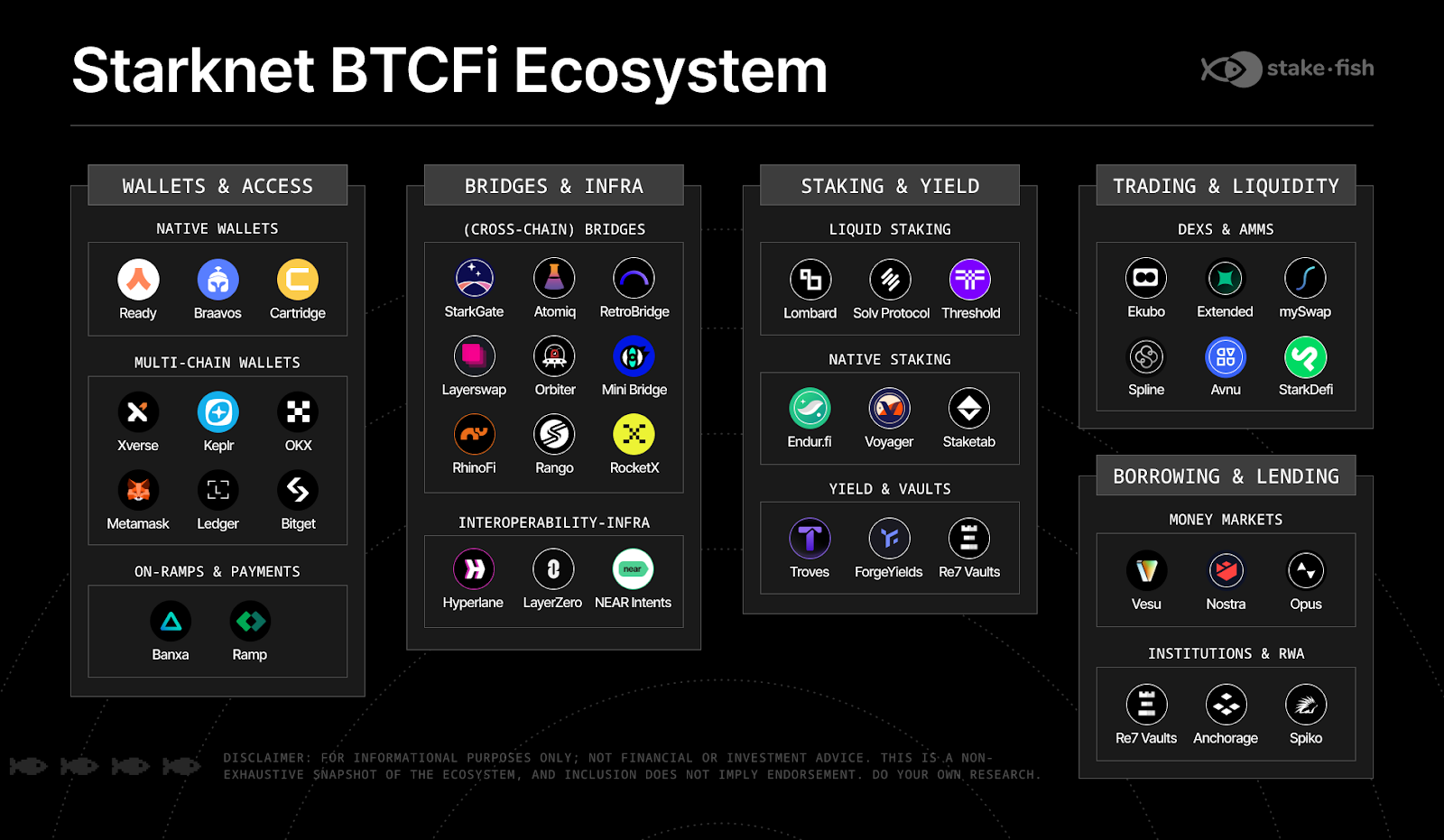
BTC Wrappers: WBTC, LBTC (Lombard), tBTC (Threshold Network), and SolvBTC are all supported for staking and DeFi on Starknet. Each wrapper has its own delegation pool per validator.
Liquid Staking: Endur provides liquid staking for both STRK (xSTRK) and BTC (xyBTC) from day one. Stakers receive a liquid token representing their staked position, which can be used across Starknet DeFi for lending, trading, or yield farming while still earning staking rewards.
Lending and Borrowing: Vesu has integrated BTC liquid staking tokens into its lending markets, allowing users to borrow stablecoins against BTC collateral. The goal is to make Starknet the most cost-effective place to borrow stables against BTC.
Yield Strategies: Re7 Capital offers a BTC-denominated yield fund (~20% APR) tokenized by Midas and available as collateral across Starknet DeFi. Troves provides one-click BTC yield vaults. 0DFinance offers automated vault strategies.
100M STRK Incentive Program: The Starknet Foundation’s "BTCFi Season" distributes 100 million STRK over six months (September 2025 through March 2026) across three priorities: BTC liquidity on DEXs, stablecoin borrowing against BTC, and ecosystem growth. This is the largest incentive program in Starknet’s history.
Privacy: Starknet recently announced strkBTC, a new BTC-based asset that enables shielded balances and confidential transfers while maintaining full DeFi composability. This positions Starknet at the intersection of BTCFi and privacy, a combination that may prove critical for institutional adoption.
The DeFi Ecosystem
Starknet’s DeFi TVL has grown significantly, driven by the influx of Bitcoin liquidity and staking programs. The ecosystem spans DEXs, derivatives, lending, stablecoins, and emerging real-world payment infrastructure. You can explore all Starknet dApps on the Starknet ecosystem page.
Key Protocols
Ekubo: The leading DEX on Starknet, providing deep liquidity for all wrapped BTC tokens, STRK, and stablecoins. Supports limit orders and multi-hook extensions.
Paradex: A high-performance perpetuals DEX built as an appchain on Starknet, incubated by Paradigm. Features zero-fee retail trading, ZK-encrypted accounts that hide positions and liquidation levels, and $244 billion in cumulative volume.
Extended: A perpetual trading platform offering up to 100x leverage, originally built on StarkEx and now migrated to Starknet.
Vesu: The primary lending and borrowing protocol, with integrated BTC liquid staking tokens and a V2 upgrade powering the BTCFi era.
Opus: A lending protocol that allows users to borrow CASH (Starknet’s first native stablecoin) against BTCFi assets, with integrated U.S. Treasury yield exposure and smart contract insurance coverage.
Noon Capital: A yield-bearing stablecoin protocol with USN (base stablecoin) and sUSN (staked version), providing BTC and USDC deposit strategies.
AVNU: A DEX aggregator that has integrated all wrapped BTC tokens and allows users to pay gas fees with BTC across the network.
Wallets and User Infrastructure
Starknet benefits from native account abstraction, meaning every wallet is a smart contract with programmable logic. This enables features like social recovery, session keys, and gas abstraction that are not possible on most other networks.
Ready (formerly Argent): The leading Starknet wallet, functioning as a crypto-native neobank. Features include direct fiat onramps from 150+ countries, integrated BTC staking, a self-custodial Visa/Mastercard debit card for real-world spending, and Google Pay integration. Apple Pay integration is expected in 2026.
Braavos: A feature-rich wallet with in-app staking, hardware signer support, and mobile-first design. Supports STRK and BTC staking directly in the wallet interface.
Keplr: A cross-chain wallet that has extended Starknet staking support, familiar to Cosmos ecosystem users.
Xverse: A native Bitcoin wallet that has integrated Starknet BTCFi capabilities, allowing BTC holders to bridge, stake, and earn directly from a Bitcoin-native wallet experience.
Cross-Chain Connectivity
Starknet has made significant progress on interoperability in recent months:
LayerZero: Now live on Starknet, connecting the network to global onchain liquidity and the token expansion standard used by 700+ tokens across 25+ chains.
NEAR Intents: Enables intent-based cross-chain swaps, allowing users to swap STRK and 100+ tokens across 25+ blockchains without traditional bridging flows.
StarkGate Bridge: The native Ethereum-Starknet bridge for depositing and withdrawing assets.
StarkWare x Alpen Partnership: Working toward a trust-minimized bridge between Bitcoin and Starknet, powered by a cryptographic verifier on Bitcoin. Expected to ship in 2026, this would remove the trust assumptions around wrapped BTC and enable native BTC bridging.
What’s Ahead: The 2026 Roadmap
Starknet’s 2026 roadmap is focused on three pillars: completing decentralization, expanding Bitcoin integration, and introducing protocol-level privacy. For a comprehensive look at what was shipped in 2025, see the Starknet 2025 Year in Review.
Staking v3 (Q1 2026): Validators will attest and vote on sequenced blocks, another step toward full decentralization of the sequencer layer.
Staking v4 (2026): The final phase of staking, enabling full decentralization of both the sequencer and prover stack.
Trust-Minimized BTC Bridging: The StarkWare x Alpen partnership aims to deliver a cryptographic verifier ("Glock") on Bitcoin, enabling BTC to be locked on Bitcoin and unlocked on Starknet only if burn/withdrawal conditions are proven. This would be a major step beyond wrapped BTC.
strkBTC and Privacy: Shielded BTC balances and confidential DeFi transactions, combining BTCFi with protocol-level privacy. Zero-knowledge proofs make Starknet uniquely positioned to deliver privacy without sacrificing composability.
STRK Burn Mechanism: A fee-burn mechanism is planned (timeline TBD), which would add deflationary pressure to the STRK token.
Why Stake on Starknet with stakefish
stakefish has been operating validator infrastructure since 2018 and currently manages $1.72 billion in staked assets across 20+ networks. On Starknet, stakefish supports both STRK and BTC delegation with:
• Non-custodial staking: your tokens stay in your wallet at all times
• Institutional-grade infrastructure with SOC 2 certification and a spotless slashing record
• Transparent monthly Validator Performance Reports
• Programmatic staking via the stakefish Starknet SDK for platforms and institutions
• Competitive commission rates with a blended average of ~2.9% across networks
Get Started
• How to Stake STRK with stakefish
• How to Stake BTC on Starknet with stakefish
• Starknet Staking Documentation
About stakefish
Founded in 2018 by Ethereum and Bitcoin veterans, stakefish is the leading validator for Proof of Stake blockchains. With support for 20+ networks, we combine institutional‑grade infrastructure with intuitive dashboards, transparent reporting, and a spotless slashing record so individuals and institutions alike can stake confidently while strengthening decentralized networks.
Visit our website 🐠 | Telegram | X | Instagram | YouTube | LinkedIn | Reddit