Ethereum staking: In-depth guide on rewards & commission
stakefish, one of the world's leading staking pools, simplifies the complexities of Ethereum staking while maximizing rewards. Our MAX MEV smoothing pool ensures consistent payouts and our transparent commission structure keeps you in control of your earning

Introduction
At stakefish, we are driven by the mission of decentralization and securing the blockchain. This mission started with our Founder & CEO, Chun Wang, whose experience in the industry goes as far back as 2013 as a co-founder of f2pool, one of the largest mining (PoW) pools for Bitcoin and Ethereum. stakefish began with specific goals for continuing the mission of Ethereum as it transitioned its consensus mechanism from proof-of-work to proof of stake.
Unique to Ethereum, reward and commission structures are complex compared to other proof of stake blockchains. There are two types of rewards: a) protocol rewards, and b) execution rewards, with a total of 5 types of sub-rewards. The commission is not implemented at the protocol level, but it is implemented specifically by the staking operator. In this guide, we'll help you understand the structure of different types of staking rewards and commissions for Ethereum staking.
Protocol rewards
Sometimes referred to as consensus rewards, the protocol rewards are for securing the network at the consensus level. It comprises 1) attestation rewards, 2) block proposal, and 3) sync committee rewards. Protocol rewards come from new issuance.
Issuance
The rewards derive from new issuance of ~0.52%. The opposite force to ETH issuance is the rate of which ETH is burned. For a transaction to execute on Ethereum, a minimum fee (known as a "base fee") must be paid, which fluctuates continuously (block-to-block) depending on network activity. The fee is paid in ETH and is required for the transaction to be considered valid. This fee gets burned during the transaction process, removing it from circulation. Ultrasound.money has a nice dashboard to see these forces.
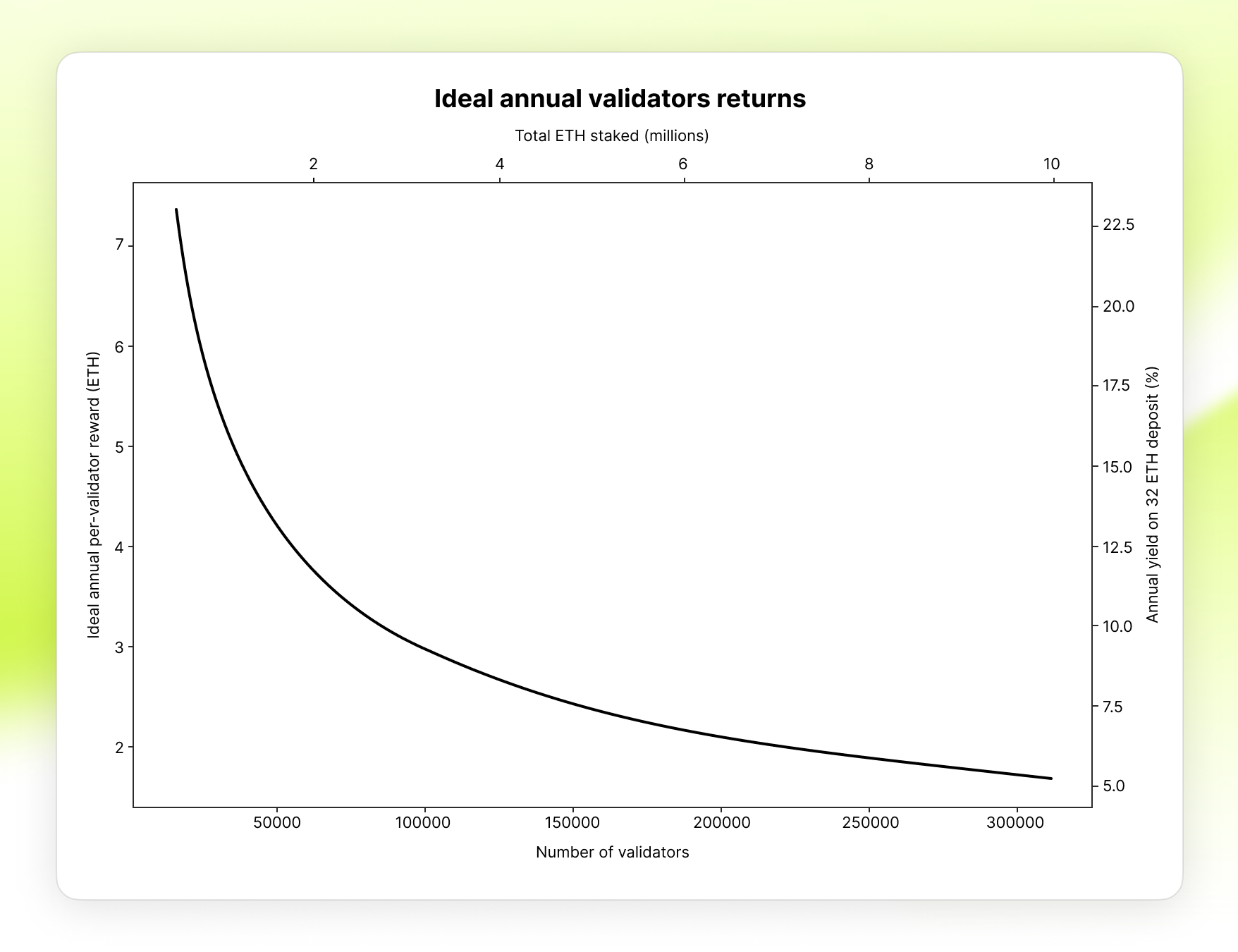
All rewards are functions of the base reward, which is proportional to the number of total validators.

To simply put, the more validators there are staked, the more rewards (APR) are spread out. To understand this easier, below is the chart of estimated APR based on the total number of validators. Sometimes this is referred to as the network reward which represents the limit of your protocol rewards can attain. To see the real-time number of validators and network APR, see validatorqueue.com.
Types of rewards
- Attestation rewards: Every epoch (6.4 minutes) the validator must "attest" by voting in favor of the validator's view of the chain. Rewards are given for submitting attestations. A common way to measure this performance is to look at the effectiveness rate. Performance and reliability play an important role in maximizing this reward.
- Proposal rewards: Proposers are randomly selected validators that are rewarded for proposing the next block to the Ethereum network. Your chance to propose a block is proportional to the total number of validators. Roughly it takes about 60 days for a single validator to propose. The rewards are relatively large.
- Sync committee rewards: A lesser-known reward type is the Sync committee, a committee of 512 validators randomly assigned by the Ethereum network every 27 hours (256 epochs). The committee's role is to sign the block header which is the new head of the chain of each slot. If chosen, the rewards are relatively large during the 27-hour period. Again, performance and reliability play an important role in maximizing this reward.
Execution rewards
A validator can also be rewarded for execution tasks each epoch. This reward is dependent on the transaction volume or the demand of Ethereum L1. It is directly related to gas fees and demand for inclusion from MEV.
Types of rewards
- Priority fee tips: The user pays the tip fee on the transaction to get prioritization from the validators to include it.
- Maximal Extractable Value (MEV): Paid by users, mainly MEV searchers looking to capitalize on trading arbitrage and liquidation opportunities. MEV is a term used to encapsulate the profit a validator can make by including, excluding, and reordering transactions in the blocks they create.
Unique to stakefish, we provide a MAX MEV smoothing pool that collects all the fee/MEV and distributes it evenly to all users with a smart contract. We leverage major MEV relays to maximize your rewards. These relays, not limited to, are: flashbots, bloxroute, blocknative, eden, ultrasound, and agnostics.
Most of our competitors do not provide a smoothing pool. This means fee/MEV fluctuates at the same rate as your block proposals, which is a high degree of fluctuation. It may take 2+ months for a single validator to see any reward. In contrast to stakefish, you can collect the reward daily with the MAX MEV smoothing pool.
Commission
Not all commissions are the same. We're here to give you the most comprehensive explanation on how they're done. Unique to the Ethereum blockchain, the commission is not as simple as a protocol setting on other blockchains. Protocol rewards are automatically swept to your withdrawal address every 4-5 days. Fee/MEV rewards go to the fee recipient address set by the staking operator. At stakefish, this is our MAX MEV smoothing pool. The commission is collected based on specific implementation by the staking operator.
Different providers use different implementations. Here are the most common approaches you'll see in the market:
Provider A pattern: ~8% retail commission, no smoothing pool. Deploys a cloned contract to capture both protocol rewards and execution rewards. The provider deducts fees directly from that contract. While it captures fees efficiently from the provider's side, it's less optimal for the user because rewards and withdrawals don't go straight to the user's account without claiming from the contract.
Provider B pattern: ~5% retail commission, no smoothing pool. Deploys a cloned contract to capture execution rewards. Based on an offline calculation from protocol and execution rewards, the provider generates a merkle proof (similar to an airdrop) and submits it to the contract. The user enters the exact value they're eligible to claim and the merkle proof to get their remaining portion of fee/MEV rewards. This avoids touching protocol rewards directly but lacks transparency due to the offline calculation step.
Provider C pattern: Fixed fee model (e.g., $240/yr), no smoothing pool. Users spin up their infrastructure like Amazon AWS and take full control of protocol and execution rewards. Lower-tier plans may not include MEV relays at all. With fixed fees, the effective commission rate fluctuates significantly because the rewards themselves fluctuate. When network rewards drop, the fixed fee becomes a larger share of total earnings.
Stakefish (BEST): Blended commission averages 4.30% over the past 6 months (Sep 2025 to Feb 2026), based on 0% on protocol rewards and 50% on the fee/MEV smoothing pool. This is the lowest blended commission in the Ethereum staking market.
- For protocol rewards, you retain full control of the withdrawal address and keep 100%, zero commission.
- For execution rewards, we have a MAX MEV smoothing pool contract that collects all of the fee/MEV from multiple relays (flashbots, bloxroute, blocknative, eden, ultrasound, and agnostics) into a shared pool.
- Fees are transparent and calculated onchain. You can claim the fee/MEV rewards directly on your staking dashboard anytime.
How our fee structure works in practice
Our commission structure charges 0% on protocol rewards and 50% on execution layer rewards. Institutional clients have a separate pricing structure that is unaffected by this standard fee schedule.
Because protocol rewards are the larger and more stable share of total Ethereum staking rewards, and because our protocol commission is 0%, the blended effective rate that stakers actually pay sits well below the headline EL number.
Over the past six months under this structure, the blended effective commission has averaged 4.30%. Monthly figures vary with MEV conditions, ranging from roughly 2% to 6%. Single-month figures are not a reliable indicator of long-run cost. The six-month average is.
If you are comparing providers, the blended effective rate is the right comparison. A provider charging 0% on EL but 10% on CL will deliver a higher blended rate than one charging 50% on EL and 0% on CL, in most market conditions, because CL is the larger reward stream.
To calculate the blended commission on both protocol and execution rewards, we collect the pool's protocol reward rate and the fee reward rate over a rolling window. Our public Dune dashboard shows this in real time.
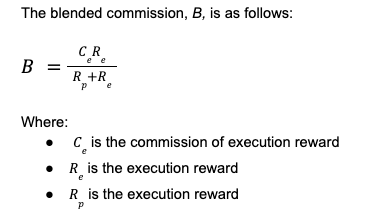
We built a Dune Analytic dashboard to help you understand the blended commission in real-time.
Staking
Stakefish provides the most powerful and friendly Ethereum dashboard in the industry. It’s engineered for the elite retail and tailored for small and large stakers alike.
- Classic staking: Ethereum staking with no contract risk, optimal gas, and stake as many as 100 validators in one go.
- Eigenlayer staking: Restake validators with Eigenlayer and generate re-staking rewards.
- Safe Multisig wallet: Connect with Safe wallet to securely stake with multisig wallet.
 stakefish
Collect Fee/MEV rewards
MAX MEV Smoothing pool means you don’t have to wait until a block proposal to collect rewards. All fees/MEV from the retail pool are collected to a smart contract and ready to be collected anytime.
Conclusion
stakefish, one of the world’s leading staking pools, simplifies the complexities of Ethereum staking while maximizing rewards. Our MAX MEV smoothing pool ensures consistent payouts and our transparent commission structure keeps you in control of your earnings. Whether you're a small or large staker, stakefish provides a reliable, user-friendly platform to grow your Ethereum staking with confidence.
Building staking into a platform? The stakefish Multi-Chain Staking API and SDK let you stake ETH and other networks from your own product. Learn more about the API and SDK.
Stake now at: stake.fish/stake
About stakefish
Founded in 2018 by Ethereum and Bitcoin veterans, stakefish is the leading validator for Proof of Stake blockchains. With support for 20+ networks, we combine institutional‑grade infrastructure with intuitive dashboards, transparent reporting, and a spotless slashing record so individuals and institutions alike can stake confidently while strengthening decentralized networks.
Visit our website 🐠 | Telegram | X | YouTube | LinkedIn